

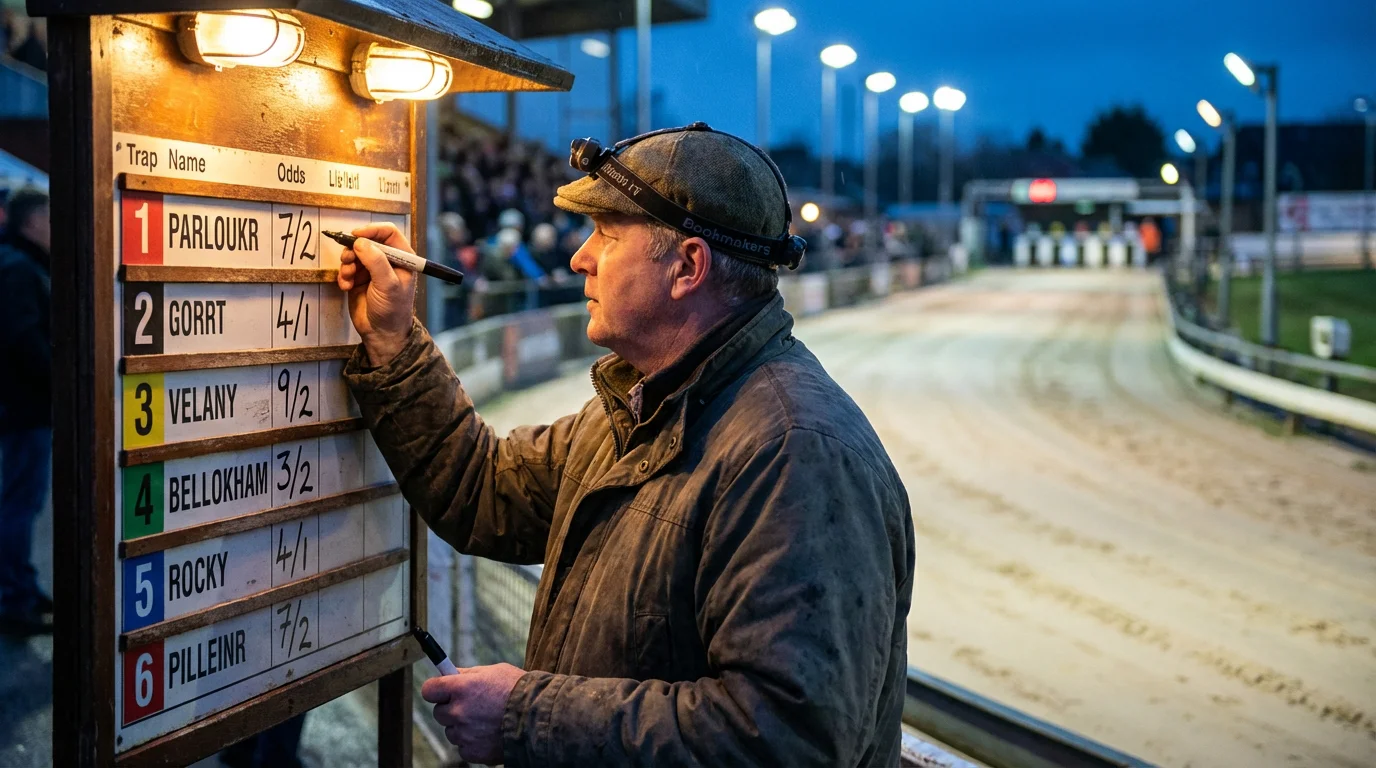
SP — The Price When the Traps Open
Starting Price is the odds on a dog at the exact moment the race begins. It’s the final price returned by the market — the number recorded in the results, used by form databases, and referenced by punters reviewing a dog’s past performances. In UK greyhound racing, SP serves a dual purpose: it’s the odds you receive if you bet at “SP” rather than taking a fixed price, and it’s the benchmark against which all other prices are measured. Find more odds guides at greyhoundderbyodds.
For bettors, SP is both a fallback and a reference point. Understanding how it’s determined, when it’s the right choice, and how it interacts with features like Best Odds Guaranteed gives you a more complete picture of the pricing landscape. Defaulting to SP without thinking about it is one approach. Using it deliberately, when the circumstances favour it, is better.
How Starting Price Is Determined in UK Greyhound Racing
On-course bookmakers set the SP. The process is inherited from horse racing and adapted for the greyhound environment, though the mechanics differ in practice due to the smaller on-course betting market at greyhound tracks.
In horse racing, SP is determined by independent assessors who survey the on-course bookmakers’ boards at the moment the race starts and calculate a representative price for each runner. The greyhound SP process follows a similar principle: the starting price reflects the odds available on course at the off. However, the on-course bookmaker presence at many greyhound tracks is smaller than at horse racing fixtures, which means the SP can be influenced by a smaller volume of money.
Online betting markets have increasingly influenced SP formation, even though the official SP remains an on-course figure. When the majority of money on a race is bet online — as is the case for most BAGS meetings and many evening cards — the on-course market effectively mirrors the online prices. The result is that the SP for most greyhound races closely reflects the consensus price across the major online bookmakers at the time of the off.
For the Derby, where betting volumes are significantly higher than standard meetings, the SP is a sharper reflection of the market’s collective view. More money has been bet, more opinions are priced in, and the SP represents a deeper consensus. This makes Derby SPs particularly useful as a benchmark for assessing whether your early prices represented value — if you took 8/1 in the morning and the SP was 5/1, your price was demonstrably better than the market’s final assessment.
SP is published alongside results for every race at every GBGB-licensed track (GBGB Racing), making it the universal pricing reference for form study. When you see a dog’s past results listed with SPs, those prices tell you how the market rated the dog on each occasion — a 2/1 SP means the market considered it a strong favourite, while a 10/1 SP means it was a relative outsider. Tracking a dog’s SP progression over several runs shows you how the market’s view of its ability is evolving.
When SP Is Better Than Taking an Early Price
If you expect the market to drift, SP can deliver a bigger return. There are specific circumstances where betting at SP is a deliberate strategic choice rather than a lazy default.
The most obvious case is when you believe a dog is overbet in the early market and will drift as the day progresses. If a dog opens at 3/1 in the morning and you expect it to drift to 5/1 by the off — perhaps because the early price was based on reputation rather than current form — then SP delivers the longer price without you needing to monitor the market throughout the day. This requires confidence in your assessment of the market dynamics, which is a skill that develops with experience.
SP is also preferable when you don’t have time to take a price before the off. Greyhound races go off at regular intervals — every twelve to fifteen minutes during a BAGS meeting — and the final-minutes market movements can be sharp. If you’re unable to place your bet until just before the off, the SP may be the only option. In this case, it’s the realistic choice rather than the optimal one.
For races where you lack strong conviction and are simply having a casual bet, SP avoids the commitment of a fixed price. You’re accepting whatever the market determines, which is a reasonable position when your opinion isn’t sharp enough to justify the risk of timing a fixed-price bet.
Where SP is definitively worse is when BOG applies. If you take an early price with BOG, you capture any drift automatically — receiving the higher of your taken price and the SP. In this scenario, taking an early price with BOG strictly dominates betting at SP, because you get the SP when it’s higher and something better than SP when it’s not. The only reason to bet at SP when BOG is available is if you haven’t formed an opinion in time to take an early price.
SP and Best Odds Guaranteed — How They Interact
With BOG, you get the better of your price and SP. It’s the best of both worlds. The interaction between SP and BOG is straightforward but worth making explicit, because many punters don’t fully grasp the combined effect.
When you take an early price with BOG: if the SP is higher than your price, you’re paid at SP. If the SP is lower, you keep your price. Either way, you receive the better number. This means your effective return is always at least as good as SP and often better. The only scenario where your return equals SP is when the SP happens to be higher than your taken price — and in that case, BOG has done its job by upgrading you.
The implication is that BOG makes SP largely redundant as a betting choice for punters who have time to take early prices. If you can assess the form and place your bet before the off, taking a price with BOG will always produce a return that is equal to or better than SP. SP remains relevant as a reference point — you can use it to evaluate your selections after the fact — but as a betting choice, it’s inferior to BOG-protected early prices in every scenario.
For Derby betting specifically, this interaction means that punters who take morning prices on heat selections with BOG are optimising their returns without any additional risk. The morning market offers prices that reflect pre-race assessment, and BOG ensures that if the race-day market settles at longer odds, those longer odds are captured. It’s a one-way valve that only lets value in.
Historical SP Data from Derby Finals
SP patterns in Derby finals reveal how the market behaves under pressure. Looking at the starting prices of Derby finalists across multiple years shows consistent patterns that inform both selection and staking decisions.
The favourite in the Derby final typically goes off between 2/1 and 7/2 — a price range that implies a 22-33% win probability. As discussed elsewhere, the actual win rate for Derby favourites falls below this range, making the favourite a consistently poor-value bet. The SPs of the second and third favourites usually sit in the 4/1 to 7/1 range, and this is the zone where the historical return on investment is strongest.
Outsiders at 10/1 and longer win the Derby final often enough to warrant attention. The SP data shows that at least one dog in most recent finals has gone off at double-figure odds, and these outsiders have produced a disproportionate number of winners relative to their implied probability. This confirms the broader finding that the Derby final is a race where the market overestimates the chance of the favourite and underestimates the field.
The spread of SPs in a typical Derby final is relatively tight compared to standard graded racing. In a graded race, the SP range might run from 6/4 to 10/1, with a clear favourite and several outsiders. In a Derby final, the range is often compressed to something like 5/2 to 8/1, reflecting the competitive parity of the six surviving dogs. This compression means that the difference in implied probability between the favourite and the outsider is smaller than in a typical race — and the value of finding the right selection at the wrong price is correspondingly higher.
Know What SP Means Before You Default to It
SP is a safety net. But an informed early price is usually sharper. Betting at SP is not wrong — it’s the right choice in specific circumstances, particularly when you lack the time or conviction to take a fixed price. But it should be a deliberate decision, not a default setting. Every time you bet at SP when you could have taken an early price with BOG, you’re leaving potential value on the table. Also read our how greyhound racing odds are set.
Understand SP for what it is: the market’s final word on a dog’s odds, determined at the moment of the off. Use it as a benchmark to evaluate your selections. Use it as a fallback when circumstances demand. But when you have an opinion and BOG is available, take the price. The SP will still be there as a comparison point after the race. Your early price, locked in and protected, will often be the better number.
