The Price You See Is Not the True Probability
Odds include the bookmaker’s margin. Understanding that margin is step one. Every greyhound race you bet on — from a Tuesday night at Crayford to the Derby final at Towcester — is priced with a built-in profit mechanism for the bookmaker. The odds you’re offered don’t represent the true probability of each dog winning. They represent the bookmaker’s assessment of probability, adjusted to guarantee a mathematical edge regardless of the outcome. Find more odds guides at greyhoundderbyodds.
This isn’t hidden. It’s the fundamental structure of how bookmaking works, and it applies to every sport and every market. But in greyhound racing, where the betting public pays less attention to odds structures than horse racing punters do, the margin is often accepted without scrutiny. Punters compare the odds on two dogs and pick the one they fancy, without asking whether either price actually offers value relative to the true chances of winning.
If you want to bet on greyhounds profitably — on the Derby or on any race — the first skill to develop is an understanding of how those odds are constructed. Who sets them, what factors they use, how the margin is applied, and why prices move before a race even starts. The odds board isn’t a neutral information source. It’s a product, built by the bookmaker, for the bookmaker’s benefit. Your job is to find the spots where it’s wrong.
How Bookmakers Compile Greyhound Odds
Compilers use form, trial times, and market expectations to build an initial tissue. The “tissue” is the bookmaker’s first-draft pricing for a race — an internal estimate of each dog’s win probability, expressed as odds, before any public money has been taken. It’s the foundation on which the final market is built.
For a standard greyhound race, the tissue is constructed from a relatively small set of inputs. Recent form figures — the dog’s finishing positions in its last five or six races — provide the baseline. Trap draw is factored in using venue-specific data on trap performance. Best times and sectional splits at the relevant distance and track give the compiler a speed assessment. Trainer form — whether the kennel has been producing winners recently — adds a further layer. For higher-profile races like the Derby, trial times and ante-post market positioning also feed into the initial assessment.
The compiler then assigns an implied probability to each dog, ensuring that the total exceeds 100%. In a six-dog race, the true probabilities of all outcomes must sum to exactly 100%. The bookmaker’s tissue sums to more — typically 115% to 120% for greyhound racing — and that excess is the overround, which represents the bookmaker’s built-in margin. Each dog’s odds are therefore slightly shorter than their true probability would dictate, which is how the bookmaker profits regardless of which dog wins.
In practice, the compilation process is partly algorithmic and partly judgmental. The major online bookmakers use pricing models that weight the key factors automatically, but human compilers still make adjustments — particularly for unusual circumstances like a dog’s first run at a new track, a trainer switching kennels, or a dog returning from injury. For the Derby, where the competition runs across weeks and form evolves between rounds, the compilation process is more dynamic than for a one-off race, with prices adjusted after each round’s results.
The initial tissue is typically published as opening odds and then adjusted as money comes in from the betting public. The price you see when you open a betting app is the current state of a continuous negotiation between the bookmaker’s assessment and the market’s collective opinion. Both can be wrong, but only one of them — yours — is risking real money on that opinion.
The Overround Explained — Bookmaker’s Edge
A six-dog race with odds summing to 117% means a 17% bookmaker margin. That number — the overround — is the single most important figure that most punters never check. It tells you exactly how much of an edge the bookmaker has built into the market, and it varies from race to race, bookmaker to bookmaker, and competition to competition.
To calculate the overround, convert each dog’s fractional odds to an implied probability and add them together. A 3/1 shot implies a 25% chance (1 divided by 4). An 8/1 shot implies an 11.1% chance (1 divided by 9). A 5/2 shot implies a 28.6% chance (2 divided by 7). Do this for all six dogs, sum the percentages, and you get the book percentage. If it totals 117%, the overround is 17%.
In UK greyhound racing, overrounds typically range from about 115% to 125%, depending on the bookmaker and the race. Lower overrounds mean better value for punters — the prices are closer to true probability, and the bookmaker is taking a smaller cut. Higher overrounds mean the opposite: every price is a little shorter than it should be, and the punter is paying more for the privilege of betting.
The Derby tends to attract lower overrounds than standard graded meetings, because the event generates higher betting volumes and bookmakers compete more aggressively for market share. Some operators run Derby specials with enhanced odds or reduced margins, knowing that the promotional value of attracting customers during the highest-profile event of the year outweighs the short-term cost of tighter margins. For punters, this means the Derby final offers some of the best raw value in the greyhound calendar — the prices are sharper, the market is deeper, and the bookmaker’s edge is thinner than on a typical Friday night card.
Why Greyhound Odds Move Before a Race
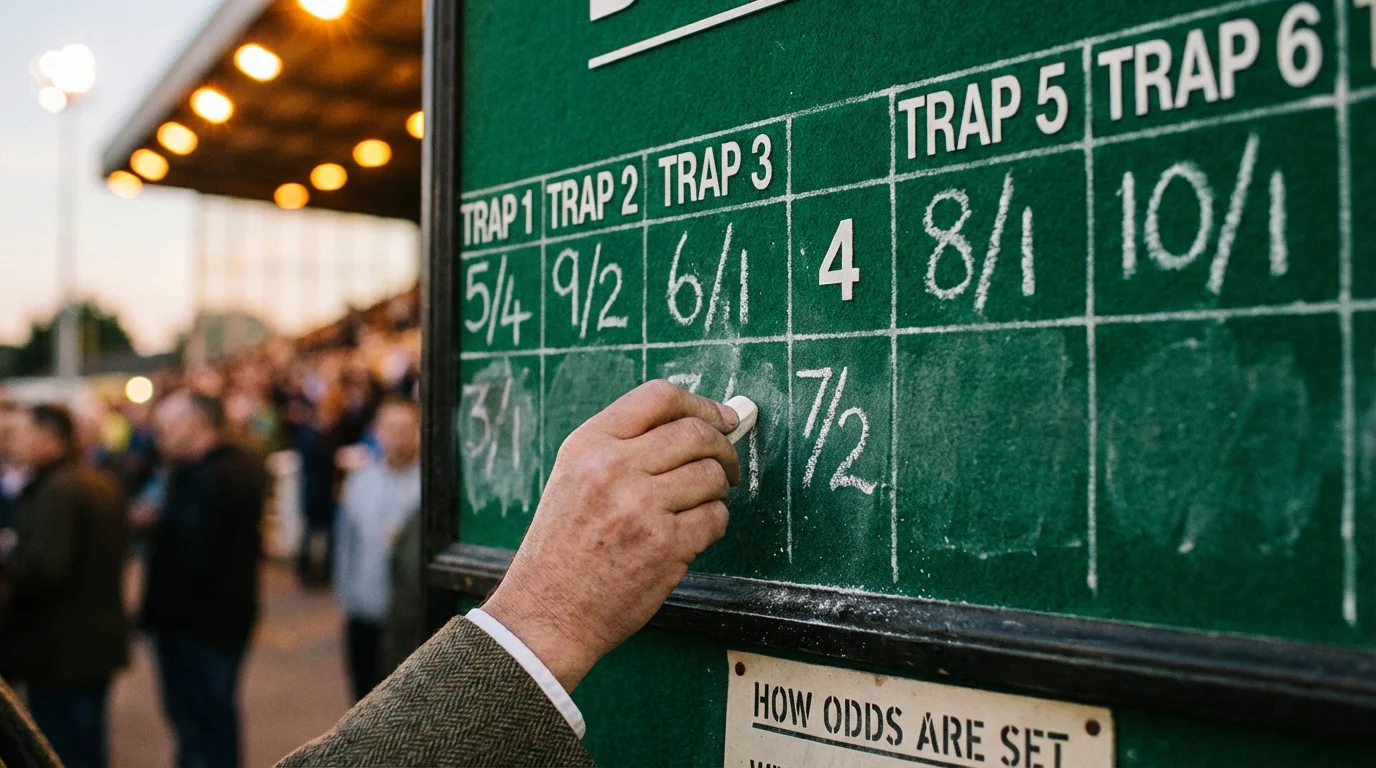
Money talks. When a dog is backed heavily, the price shortens for everyone. Bookmakers don’t set a price and leave it static — they manage a live market, adjusting odds in response to where the money flows. If a 5/1 shot attracts a disproportionate share of bets, the bookmaker shortens it to 4/1 or 7/2 to limit their exposure. Other dogs in the race typically drift slightly longer to compensate, maintaining the overall book percentage near its target.
In greyhound racing, price movements tend to be sharper and later than in horse racing. The greyhound market is smaller, with fewer bettors and lower total turnover per race, which means individual bets carry more weight. A single substantial wager on a 10/1 outsider can move its price two or three points within minutes, whereas the equivalent bet in a horse racing market would barely register. This volatility creates both risk and opportunity for greyhound punters.
Tracking where the money goes — known as “following the market” or “reading the boards” — is a skill in itself. A dog that opens at 7/1 in the morning and trades at 4/1 by the off has been backed significantly, which usually indicates informed money. Kennel connections, regular followers of the trainer’s dogs, and professional punters tend to move early. When they do, the price contracts and the rest of the market adjusts. If you’re watching the odds movements before a Derby heat, a sharp contraction on one dog often signals that those closest to the kennel like what they’ve seen in preparation.
The reverse pattern — a dog drifting from its opening price — carries information too. A 3/1 favourite that drifts to 4/1 and then 5/1 suggests the early money isn’t backing it, and the market is reassessing its chances downward. Drifters don’t always lose, but the market’s collective wisdom tends to be more accurate than any individual punter’s opinion, so a significant drift should prompt you to reconsider rather than dismiss.
Best Odds Guaranteed — What It Means for Greyhound Bettors
BOG means you get the better of your taken price and the SP. Most major UK bookmakers offer Best Odds Guaranteed on greyhound racing, and it’s one of the most valuable promotions available to punters — yet many don’t fully understand how it works or why it matters.
Here’s the mechanism. You back a dog at 5/1 in the morning. By the time the race goes off, the starting price has drifted to 7/1. Under Best Odds Guaranteed, you’re paid at 7/1 — the higher price — even though you took 5/1. If the SP had contracted to 3/1 instead, you’d keep your 5/1. In every scenario, you get the better outcome. It removes the timing risk of taking an early price and finding out the SP would have been more generous.
For Derby betting, BOG is particularly useful in the heats and semi-finals, where prices can move significantly between the morning market and the off. Taking an early price on a dog you’ve assessed gives you the security of locking in your position while retaining the upside if the market moves in your favour. Without BOG, you’d face a genuine dilemma: take the current price and risk missing a drift, or wait for the SP and risk a contraction. BOG eliminates that dilemma.
Not every bookmaker offers BOG on every greyhound meeting, and the terms vary. Some restrict it to certain tracks or specific meeting types. Check the operator’s terms before assuming your Derby bet qualifies. When it does apply, it’s an unambiguous advantage — free value that costs you nothing and improves your returns on any bet where the SP exceeds your taken price.
The Margin Is Your Opponent — Price It Accordingly
Value betting starts with understanding what the bookmaker has already built into the price. Every set of greyhound odds contains a margin that works against you — silently, consistently, on every bet you place. The overround doesn’t care whether you back the favourite or the outsider. It applies to both, and over time, it grinds down anyone who doesn’t account for it. Also read our greyhound betting odds comparison.
The counter is knowledge. Know how the tissue is compiled. Know how to calculate the overround. Know what price movements mean and when to act on them. Use BOG when it’s available. And above all, develop your own assessment of each dog’s true probability — independent of the bookmaker’s pricing — so you can identify the spots where the market has mispriced the race. The margin is always there. Your edge comes from the moments when the margin isn’t enough to cover the bookmaker’s error.
