Best Greyhound Betting Sites – Bet on Greyhounds in 2026
Loading...
- Betting on the Derby Is Not Like Betting on a Tuesday Night at Harlow
- Every Bet Type Available on the Greyhound Derby
- Understanding Greyhound Derby Odds Formats
- Ante-Post Betting on the Greyhound Derby
- How to Read a Greyhound Race Card
- Starting Price vs Early Price — When to Take a Number
- In-Play and Live Betting on Greyhound Races
- The Bet Starts Before the Traps Open
Betting on the Derby Is Not Like Betting on a Tuesday Night at Harlow
The Derby runs across six weeks — your betting approach needs to match that timeline. Most greyhound betting happens in a compressed window: you study the card, watch the parade, take a price, and the race is over in thirty seconds. Repeat six times in an evening. That rhythm works for a Wednesday card at Harlow or a Saturday night at Romford. It does not work for the English Greyhound Derby.
The Derby is a knockout tournament. Over 180 dogs enter in late April, and six survive to the final at Towcester in early June. The competition is staged across first-round heats, second-round heats, quarter-finals, semi-finals, and a final — each round reshuffling the field, the trap draws, and the betting market. If you treat it like a single race, you will miss the structural edges that the format creates. If you approach it as an evolving event with distinct betting windows at each round, the Derby becomes one of the most interesting wagering propositions in British sport.
This guide walks through everything a punter needs to bet on the Greyhound Derby with confidence: the markets available, how odds work, when to engage the ante-post market, how to read a race card, and when to take a fixed price versus waiting for the SP. Whether you are placing your first greyhound bet or looking to sharpen an approach you have used for years, the material here is built for practical application — on Derby night and every round leading up to it.
Every Bet Type Available on the Greyhound Derby
Start with win bets, but the Derby opens up markets you won’t find on a regular card. A standard Tuesday evening meeting offers win, place, each-way, and forecast on individual races. The Derby adds outright winner markets, ante-post betting weeks before the final, tricast opportunities, and — depending on the bookmaker — specials like top trainer, qualifying-round accumulators, and without-the-favourite markets. The range is broader because the event is bigger, and the liquidity is deeper because more money flows into a prestige race.
Understanding which market to use at which stage of the competition matters as much as picking the right dog. An each-way bet in the first round, where most runners are unfamiliar to casual punters and the field is full of unknowns, serves a different purpose from an each-way bet in the final, where the six-dog field and weeks of public form data produce a tighter market. Below is a breakdown of every bet type you are likely to encounter during the Derby, starting with the straightforward and working towards the exotic.
Win, Place, and Each-Way Bets Explained
A win bet is exactly what it sounds like: you back a dog to finish first. If it wins, you collect at the agreed odds. If it finishes second or worse, you lose your stake. In greyhound racing, win bets settle quickly — there is no photo-finish stewards’ inquiry lasting twenty minutes, though dead heats do occasionally occur and are settled by splitting the payout.
A place bet backs your selection to finish in one of the designated places, usually first or second in a six-dog race. Place odds are shorter than win odds because the probability of placing is higher. Most bookmakers do not offer standalone place betting on greyhounds as a default, but it is available through each-way betting.
An each-way bet is two bets in one: a win bet and a place bet at the same stake. If you put five pounds each-way on a dog at 10/1, you are staking ten pounds total — five on the win and five on the place. The place part typically pays at one-quarter of the win odds. So if your dog finishes second, you lose the win stake but collect at 10/4 (or 5/2) on the place part. In the Derby final — a six-runner race — each-way terms are usually 1/4 odds for first and second. This makes each-way particularly useful when you fancy a dog to be competitive but are not fully confident it will win. The Derby’s tight, high-quality fields mean that finishing second has real value.
Forecast, Tricast, and Combination Bets
A forecast bet requires you to predict the first and second dogs in the correct order. A straight forecast on dogs finishing first and second as predicted pays significantly more than a win bet because the probability is much lower. In a six-dog Derby heat, a straight forecast with both selections at reasonable prices can return twenty to fifty times your stake, depending on the market. A reverse forecast covers both possible orders — your two selections first and second in either combination — but costs double the stake since it is effectively two bets.
A tricast takes it further: first, second, and third in the exact order. The payouts can be substantial — triple-figure returns are not uncommon in greyhound tricasts — but the hit rate is low. In a six-dog field, there are 120 possible first-second-third combinations. Even if you have a strong view on two dogs, the third slot introduces enough randomness to make straight tricasts a low-frequency play. Combination tricasts, which cover all possible orderings of your three chosen dogs, cost six times the unit stake but remove the need to predict the exact sequence.
For Derby semi-finals and the final itself, forecast and tricast markets attract more attention than on a regular card because the runners are better known and more thoroughly analysed. When you have watched five rounds of form on the same dogs, you may well have a view on the likely first two that justifies a straight forecast. The maths rewards confidence — if your analysis is sharp, forecasts and tricasts turn marginal edges into meaningful payouts.
Understanding Greyhound Derby Odds Formats
Fractional, decimal, or American — the numbers say the same thing differently. Most UK bookmakers default to fractional odds for greyhound racing, though decimal display is increasingly common on betting exchanges and some online operators. If you only ever bet in one format, you can get by. But if you compare prices across multiple bookmakers — and for the Derby, you should — being fluent in at least fractional and decimal saves time and prevents mistakes.
Odds are not predictions. They are a representation of probability adjusted for the bookmaker’s margin. A dog priced at 4/1 is not being predicted to win one in five times — the bookmaker is offering a payout structure that would be profitable for them if the dog won at that approximate frequency. Understanding this distinction is the foundation of informed betting. The odds tell you what the market thinks. Your job is to decide whether the market is right.
Fractional Odds and How UK Bookmakers Display Them
Fractional odds are the traditional UK format and still dominate greyhound racing displays. The fraction shows profit relative to stake: 5/1 means five pounds profit for every one pound staked, plus your stake back, so a one-pound bet at 5/1 returns six pounds total. Shorter prices like 6/4 mean six pounds profit for every four staked — or, simplified, 1.5 pounds per pound, returning 2.50 on a one-pound bet.
Where it gets less intuitive is the odds-on range. A dog at 4/6 is favoured to win — you stake six to profit four. The shorter the fraction gets, the more the market believes the dog will win and the less you get back per pound risked. In Derby finals, the favourite typically goes off somewhere between 6/4 and 5/2, which means the market considers it the likeliest winner but far from certain. Knowing how to read these numbers at a glance matters when prices move in the last few minutes before a race and you need to decide quickly whether to take the available number.
Calculating Implied Probability from Odds
Every set of odds implies a probability. Converting between the two is the single most useful mental exercise a bettor can perform. The formula is simple: for fractional odds of A/B, the implied probability is B divided by (A + B), expressed as a percentage. At 4/1, the implied probability is 1/(4+1) = 20%. At 2/1, it is 33.3%. At 6/4, it is 40%.
For decimal odds — which show total return including stake — the conversion is even simpler: divide 100 by the decimal price. Decimal 5.0 equals 20% implied probability. Decimal 3.0 equals 33.3%. If a bookmaker prices a dog at decimal 5.0 and you believe its true chance of winning is 25%, you have a value bet: the bookmaker is offering a price that implies a 20% chance on a dog you rate at 25%.
In a six-dog Derby race, the sum of all implied probabilities will always exceed 100% — that excess is the bookmaker’s overround, their built-in margin. A typical greyhound race overround sits between 115% and 120%. The Derby final, with its higher profile and larger betting volumes, tends to run closer to 112-115%, which is comparatively competitive. Knowing the overround tells you how much margin the book is carrying and whether you are betting into a generous or tight market.
Ante-Post Betting on the Greyhound Derby
The ante-post market is where the real value lives — and where the risk is highest. Ante-post betting on the Greyhound Derby opens months before the first heat, sometimes as early as the winter preceding the spring tournament. At that stage, bookmakers are pricing dozens of potential entrants based on open-race form, kennel reputation, trial times, and educated guesswork. The odds are longer because the uncertainty is greater, and that uncertainty is exactly what creates opportunity for punters who do their homework early.
The defining feature of ante-post betting is the absence of a safety net. Once the market shifts to race-day pricing, you get your stake back if a dog is withdrawn — the bet is void. In the ante-post market, there is no such protection. If you back a dog at 20/1 in January and it picks up an injury in March, your money is gone. That risk is priced into the odds: ante-post prices are always longer than the equivalent dog would attract closer to the event, precisely because the bettor absorbs the withdrawal risk.
For the Derby specifically, the ante-post market has a particular rhythm. Prices are widest — and most volatile — in the early months. Once the entry list is published and the first-round draw is made, the market narrows. After each subsequent round, dogs that have performed well shorten and those that have disappointed drift or are removed entirely. By the semi-final stage, the ante-post market begins to converge with on-the-night pricing, and the value windows that existed six weeks earlier have largely closed.
Ante-Post Rules — No Runner, No Return
The fundamental ante-post rule in greyhound racing is straightforward: if your selection does not run, you lose your stake. There is no void bet, no refund, no consolation. This applies regardless of the reason — injury, retirement, failure to qualify from an earlier round, or a trainer’s decision to withdraw. The bookmaker accepted your bet on the understanding that you were taking a risk on the dog’s participation, and the price reflected that risk.
This rule changes how you should think about selection. In regular race-day betting, you assess whether a dog will win. In ante-post betting, you also need to assess whether it will still be competing when the race comes around. A dog with recurring muscle injuries is a worse ante-post proposition than its form suggests, even if it is more talented on paper. A dog from a trainer who historically enters multiple runners and withdraws some before the heats is a different kind of risk. Ante-post discipline means factoring in participation probability, not just winning probability.
Some bookmakers offer “non-runner, no bet” specials on selected Derby markets, usually at significantly shorter odds than the standard ante-post price. These can be worth considering if you want ante-post exposure without the withdrawal risk, but the price difference is the bookmaker’s way of telling you exactly how much that safety net is worth. In most cases, the standard ante-post price at longer odds offers better expected value for punters comfortable with the risk.
When to Place Your Ante-Post Derby Bet
There are three windows where ante-post Derby betting tends to offer the best risk-reward balance. The first is the deep ante-post phase, typically January to March, when the market is widest and the longest prices are available. At this stage, you are betting on dogs whose Derby credentials are speculative — maybe they have run fast open-race times, maybe their trainer has a strong Derby record, maybe they are lightly raced and improving. The information is thin, the odds are fat, and the risk of non-participation is highest. This window suits punters who follow the sport year-round and can spot early signals that the wider market has not yet priced.
The second window opens once the first-round heats are complete. By this point, you have seen every dog race on the Derby track. First-round times, trap behaviour, and early-round pace tell you more than months of open-race form at other venues. The market has adjusted from the original tissue but has not fully priced in what the first round revealed. Dogs that ran well from awkward draws or posted fast sectionals without being pressured may still carry generous ante-post prices because the headline result — a narrow second, a third behind a well-backed favourite — did not make them obvious contenders.
The third window is after the semi-final draw but before the semis are run. By now, only twelve dogs remain, and the draw itself creates value. A strong dog drawn in a weaker semi-final heat is more likely to reach the final than an equally strong dog drawn against two other leading contenders. The market sometimes underestimates the impact of the semi-final draw, and a window of opportunity opens between the draw announcement and the semi-final races. After the semis, the ante-post market essentially becomes a final-night market, and the value is largely gone.
How to Read a Greyhound Race Card
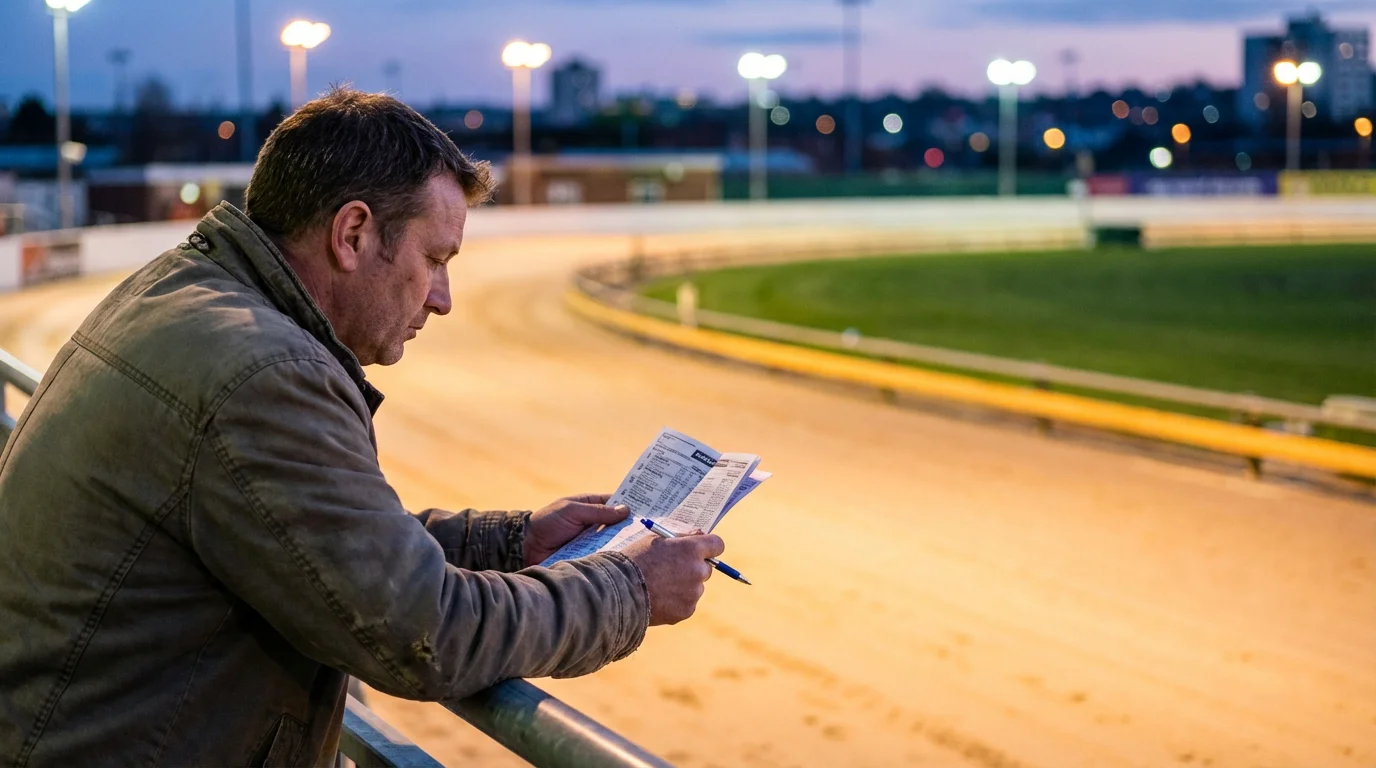
Every number on the card is a clue — if you know what to look for. The greyhound race card is the primary information tool for any bettor, and during the Derby, it becomes even more important because you are comparing dogs across multiple rounds of competition at the same venue. Unlike horse racing, where a form guide might run to pages of commentary, the greyhound card is compact and numeric. It packs a lot of data into a small space, and reading it fluently is a non-negotiable skill.
Derby race cards are published before each round by the track (Towcester) and reproduced across betting sites, the Racing Post, and dedicated greyhound data services. The card for a Derby heat contains the same elements as any GBGB-licensed race card, but the context is different: you are not just assessing a dog against five opponents in a single race, you are building a picture that will inform your betting across subsequent rounds. A dog’s trap draw, time, and running style in the first round becomes a data point that you carry forward to the quarter-finals and beyond.
What Each Column on the Race Card Means
The trap number is listed first, running from one to six, with each trap assigned a standard jacket colour: red for trap one, blue for two, white for three, black for four, orange for five, and striped black-and-white for six. The trap number matters enormously in greyhound racing because it determines the dog’s starting position relative to the first bend and influences its likely racing line for the entire 500 metres.
Next to the trap number is the dog’s name, followed by its trainer. For Derby punters, the trainer column is not decoration — kennel form in the competition’s earlier rounds can indicate whether a dog is being peaked for the final or is already at its ceiling. The dog’s weight in kilograms is listed, typically accurate to 0.1kg. Weight fluctuation between rounds can signal fitness changes, though the range is narrow in greyhounds and a shift of more than 0.5kg between runs warrants attention rather than alarm.
The card shows the dog’s recent finishing positions as a compressed form line — a string of digits like 1112 or 3651 — reading left to right from most recent to oldest. Below or beside this, you will find the dog’s best recorded time over the race distance, its sectional time to the first bend, the date and venue of its last run, and its current grade. Some cards include a brief comment from the racing manager or form analyst, usually one or two words summarising the dog’s running style: “railer,” “wide,” “mid-div” and similar shorthand.
Decoding the Form Line
The form line is the single most information-dense element on the card, and it rewards careful reading. A dog showing 1111 has won its last four races — strong on the surface, but you need context. Were those wins at the same grade, or did the dog rise through the ranks and is now facing stiffer competition? Were they at the Derby venue, or at a smaller track with a different geometry? A sequence of firsts at Crayford tells you the dog is fast in tight spaces. It tells you less about how it will handle Towcester’s wider bends.
Conversely, a form line of 3226 might look mediocre, but if those runs were against open-class opposition at Category One tracks, the dog may be far more competitive than a 1111 dog from lower-grade racing. The number alone is incomplete without the grade column and venue context. During the Derby, this layered reading becomes easier because every dog is running at the same venue against broadly similar opposition. By the quarter-finals, you have form lines generated entirely within the competition itself, which removes the cross-track comparison problem that complicates regular greyhound form analysis.
Letters in the form line carry specific meaning. “T” indicates a trial run, not a competitive race. “F” marks a fall. “S” means the dog was slow away from the traps. These flags are not just cosmetic — a dog that has shown “S” in two of its last four starts has a box-speed problem that could be decisive in a six-dog field where the first bend is often contested by four runners simultaneously.
Starting Price vs Early Price — When to Take a Number
Take a price when you have an opinion. SP is for when you don’t. The starting price is the last price available on a dog at the moment the traps open. It is set by the on-course bookmakers based on the weight of money in the ring, and it can move significantly in the final minutes before a race. If you take an early price — say, 5/1 offered in the morning — and the dog drifts to 8/1 by the off, you have taken a shorter price than you needed to. If it shortens to 3/1, you have secured value that disappeared.
For Derby heats in the earlier rounds, the market is thinner and early prices can be volatile. A well-supported dog might open at 2/1 in the morning and close at 6/4, while a less fancied runner drifts from 8/1 to 12/1. If you have done your homework and have a specific view — “this dog’s first-round sectional tells me it’s being underestimated” — taking the early price locks in your assessment before the market catches up. Best Odds Guaranteed, offered by several major bookmakers on greyhound racing, protects you by paying the higher of your early price and the SP, which removes the downside of taking a number early.
SP makes sense when you genuinely do not know what to expect — when you have not studied the card, when the form is ambiguous, or when you are making a last-minute decision at the track without time for analysis. It also makes sense in races with very limited liquidity, where early prices may not reflect true market sentiment and the SP is a more honest number. For the Derby final, though, where you have had weeks of accumulating data and the market is deep, an informed punter almost always benefits from taking an early price on their selection rather than leaving it to the vagaries of the ring.
In-Play and Live Betting on Greyhound Races
In-play greyhound betting is fast, brutal, and not for everyone. A 500-metre race at Towcester lasts approximately twenty-nine seconds. There is no halftime, no interval, no natural pause for reflection. From the moment the traps open, the race is unfolding at forty miles per hour and any in-play market reflects that velocity. In-play betting on greyhounds is available through some exchanges and selected bookmakers, but it operates in a very different context from in-play football or cricket where matches run for hours and the market adjusts gradually.
What in-play does offer is the ability to react to the start. If your dog pings the lids and leads into the first bend, you might cash out or lay on an exchange to guarantee profit regardless of what happens on the run home. If it misses the break and is three lengths off the pace by the first turn, you know within four seconds that your pre-race assessment was wrong. The information arrives quickly and decisively. But the window to act on it is vanishingly small, and the prices move just as fast.
For the Derby final specifically, in-play liquidity on exchanges like Betfair is higher than for a standard meeting, which makes it the one greyhound race of the year where in-play trading is genuinely viable. Even so, it is a specialist activity that requires fast internet, pre-set positions, and the ability to make decisions under extreme time pressure. If that describes your betting style, in-play adds a dimension. If it doesn’t, there is no shame in placing your bet before the off and watching the race without a trading screen in front of you.
The Bet Starts Before the Traps Open
The strongest Derby punters have already taken their positions weeks before the final. They watched the first-round heats, noted which dogs handled Towcester’s bends cleanly, identified which trainers had their runners peaking at the right time, and engaged the ante-post market while the prices still carried value. By the time final night arrives, their betting is largely done. The final itself is the conclusion, not the beginning.
That does not mean there is no value on the night. Late withdrawals, unexpected trap draws in the final, and market overreactions to semi-final performances can all create final-night opportunities. But the punter who arrives at the Derby final having done the work across the preceding weeks is better positioned to recognise those opportunities than someone opening a race card for the first time at seven o’clock on a Saturday evening in June.
The 2026 Derby at Towcester will follow the same structure it has for the last several years: weeks of heats building to a six-dog final on a sand track where the first bend decides most races. The markets, the mechanics, and the odds formats covered in this guide will all apply. The only variable that changes every year is the dogs. Everything else is preparation — and preparation is the part you control.