Best Greyhound Betting Sites – Bet on Greyhounds in 2026
Loading...
180 Dogs Enter. Six Reach the Final.
The first heat runs in late April. The final is in early June. Everything between is elimination. The English Greyhound Derby is not a single race. It is a knockout tournament that takes over 180 entries and reduces them, round by round, to a final six. The process takes approximately six weeks, and every stage of it — from the first-round heats to the semi-finals — generates information, shifts the betting market, and eliminates dogs that cannot sustain their form across multiple races on the same track.
For punters, the tournament structure is not background detail. It is the mechanism that creates the betting market. The ante-post odds you see in February reflect guesswork about which dogs will survive to the final. The odds available after the first round reflect the first real data from Towcester. By the semi-finals, the market is pricing dogs with five rounds of venue-specific form. Understanding when the market adjusts — and when it lags — is the foundation of Derby betting strategy, and that understanding starts with knowing how the rounds work.
This article maps the entire Derby format from entry to trophy, explaining the format, qualification rules, and betting angles at each stage. If you are betting on the Derby at any point in its timeline, you need to know what has happened before your bet and what is still to come.
The Full Tournament Structure at a Glance
Six rounds, spread across six weeks, each with different stakes for punters. The Derby’s knockout structure follows a straightforward progression: first-round heats, second-round heats, quarter-finals, semi-finals, and the final. Each round is held at Towcester over the standard 500-metre distance on sand. Dogs qualify from one round to the next by finishing in the top positions in their heat, with the fastest losers from each round also progressing to fill any remaining slots.
The field shrinks rapidly. Over 180 entries are split across first-round heats of six dogs each — roughly thirty heats in the opening round. By the second round, the field has been cut to around seventy. The quarter-finals reduce it further to approximately twenty-four. The semi-finals take twelve, and the final features six. At each stage, the quality of opposition increases because the weaker dogs have been eliminated. A dog that won its first-round heat comfortably may find the quarter-finals a far sterner test, simply because every remaining runner has already demonstrated it belongs at this level.
The entire competition is held at Towcester, which has a critical implication for bettors: every round generates directly comparable data. A first-round time of 29.30 and a semi-final time of 29.30 were recorded on the same track, over the same distance, under broadly similar conditions. This eliminates the cross-venue comparison problem that plagues regular greyhound form analysis and gives the Derby punter a uniquely clean dataset to work with as the tournament progresses.
Between rounds, the trap draw is conducted afresh. A dog that ran from trap one in the first round might draw trap five in the second. This reshuffling means that no runner benefits from a consistently favourable draw — over six rounds, every dog will face both good and bad draws, and the ones that perform regardless are the genuine contenders. The draw itself becomes a betting factor: when it is announced for each round, the market reacts, and the window between the draw announcement and the race is one of the best value-finding opportunities in the entire competition.
Round One — The Opening Heats
Round One is where you see the most dogs at the longest odds. The opening heats are the widest part of the funnel — the full entry list, split into groups of six, racing for the first time on the Derby track. For many dogs, this is their first run at Towcester, and the gap between pre-tournament expectation and actual performance can be enormous. A dog that looked outstanding in open-race form at its home track may struggle to adapt to a different surface, a different bend geometry, or the intensity of competition that the Derby attracts. Equally, a dog that entered the tournament as an afterthought might post a time that reshapes the entire ante-post market.
The first round serves two purposes in the Derby’s design. It is a qualification gate — only the winners and selected fastest losers advance — but it is also an information event. The times, sectionals, trap behaviour, and running styles observed in round one become the foundation of every subsequent assessment. A punter who watches the first-round heats carefully, rather than relying on the headline results, gains a significant advantage over anyone pricing the later rounds from incomplete data.
Number of Heats and Qualification Rules
The first round typically comprises around thirty heats, scheduled across two or three evenings of racing at Towcester. Each heat features six dogs, and the primary qualification rule is straightforward: the winner of each heat progresses automatically to the second round. The remaining slots are filled by the fastest losers — dogs that finished second or third in their heats but posted times quick enough to merit a second-round place.
The fastest-loser system means that a strong dog drawn in a tough heat is not necessarily eliminated by a single defeat. If the heat contained two or three high-class runners and the second-placed dog posted a time faster than the winners of several other heats, it qualifies as a fastest loser and stays in the competition. This safety net prevents the random element of the draw from completely dictating the tournament, though it does not eliminate draw influence — a dog that wastes energy in a contested first bend because of an unfavourable trap still has a harder path than one that leads unchallenged from a kind draw.
Betting Angles in the Opening Round
The betting angles in round one are different from any other stage of the competition. The fields contain a wider range of quality than you will see in later rounds, which means standout dogs can be very short — sometimes odds-on — while others drift to double-figure prices. The value in round one is not usually in backing short-priced heat favourites to win. It is in assessing which dogs handle Towcester well enough to be competitive in the later rounds, and then engaging the ante-post market on the basis of that first-hand observation.
Each-way betting is useful in round one because the gap between winning and qualifying as a fastest loser can be narrow. A dog that finishes second in a strong heat, posting a quick time, may be a better ante-post proposition than one that won a weak heat slowly. The each-way market lets you back those second-place finishers while recovering some stake if they miss out entirely. If you are not betting on individual heats, the most productive use of round one is to watch, take notes on sectional times and running styles, and use that information to inform your ante-post positions for round two onwards.
Rounds Two to Four — The Elimination Grind
The middle rounds are where form firms up and the ante-post market starts to crystallise. Rounds two through four — the second-round heats, third-round heats, and quarter-finals — make up the bulk of the Derby’s competitive schedule. The field narrows significantly at each stage, and the quality of opposition rises with every round. By the quarter-finals, every surviving dog has won or placed in multiple rounds at Towcester, which means the form data is substantial and the remaining uncertainty is genuine rather than a product of limited information.
For punters, the middle rounds are the analytical core of the Derby. The early rounds provided raw data; the middle rounds test whether that data is durable. A dog that posted a fast first-round time might slow down in the second round as the opposition improves. Another dog that looked ordinary in round one might improve significantly as its trainer adjusts the preparation. The market reacts to these developments, but not always at the speed or accuracy that the underlying information warrants.
How Fastest Losers and Re-Draws Work
The fastest-loser system continues through the middle rounds, ensuring that strong dogs are not eliminated by a single tough draw. After each round, the heats are reconstituted from the surviving pool — dogs are re-drawn into new groups, which means the composition of every heat changes from round to round. A dog that faced two leading contenders in round two might draw a weaker group in round three, or vice versa. This reshuffling is intentional: it prevents the same dogs from meeting repeatedly and ensures the tournament tests versatility rather than rewarding a fortunate draw path.
The re-draw process itself is worth tracking as a bettor. When the draw for each round is announced, the market adjusts immediately — dogs in apparently softer heats shorten, while those drawn against strong opposition drift. But the adjustment is not always proportionate. The market tends to react to the names in each heat rather than to the specific trap assignments within the heat, which means a dog drawn in a tough heat but with a favourable trap position may be underpriced relative to its actual probability of qualifying.
When to Adjust Your Derby Positions
The middle rounds are the best time to adjust your ante-post positions. By the quarter-final stage, you have three rounds of Towcester data on every surviving dog, which is enough to form a robust view on each runner’s form trajectory, preferred running style, and physical condition. The ante-post market is still open, and the prices — while shorter than they were before round one — still offer value on dogs whose round-by-round improvement the market has not fully absorbed.
The specific adjustment depends on what the rounds have revealed. If your pre-tournament selection has progressed but is showing signs of fatigue — slower run-home times, a heavier weight, a less convincing first-bend split — it may be time to reduce your exposure, either by hedging or by mentally downgrading its chances. If a dog you did not initially fancy has emerged as a strong contender through a sequence of improving performances, the middle rounds are the time to take a position before the market shortens the price further ahead of the semi-finals.
Individual heat betting in the middle rounds follows the same principles as round one but with better information. The fields are stronger, the form is deeper, and the prices are generally shorter. Value in middle-round heat betting tends to come from trap-draw analysis — identifying dogs that are well drawn for their running style in a specific heat — rather than from identifying outright talent mismatches, which become rarer as the competition narrows.
The Semi-Finals — Two Heats, Six Finalists
The semis are the real Derby. The final is just the conclusion. This is not quite literal, but the sentiment captures something important: by the time twelve dogs are split into two semi-final heats, the Derby’s competitive structure has done its work. Every survivor has proved its quality across multiple rounds. Every pretender has been eliminated. The two semi-finals determine which six dogs reach the final, and the margin between qualifying and going home is often a length or less.
The semi-finals are also the point where the betting market reaches its sharpest focus. The twelve remaining dogs have extensive Towcester form, clearly established running styles, known trap preferences, and well-documented trainer patterns. The information asymmetry that created value in the early rounds is largely gone — almost everything is known, and the prices reflect that knowledge. Value in the semi-finals comes from subtlety: a draw advantage within a specific heat, a dog whose improving run-home times suggest it has not yet peaked, or a market overreaction to a single impressive quarter-final performance that may have been draw-assisted rather than merit-driven.
Semi-Final Draw and Heat Structure
The twelve semi-finalists are drawn into two heats of six, with the winner and second-placed dog from each heat qualifying automatically for the final. The remaining two final places are typically filled by the fastest losers from across the two semi-final heats. This format means that four of the six finalists earn their place through finishing position and two earn it on time — a distinction that matters for betting because a fastest-loser qualifier may have faced a harder semi-final heat than a winner of a weaker one.
The semi-final draw is conducted publicly and covered by racing media, which means the market reacts immediately. The split is crucial: if the twelve dogs divide into one clearly stronger heat and one weaker one, the weaker heat becomes the route to the final for its participants and the prices adjust accordingly. Experienced Derby punters watch the draw announcement as closely as they watch any race, because the composition of each semi-final heat reshapes the probability landscape for the entire final.
Semi-Final Betting Markets and Value
Semi-final betting markets operate on two levels: the individual heat market and the outright Derby market. The heat market prices each of the six dogs in a semi-final to win that specific race, while the outright market adjusts the ante-post prices for every surviving dog based on their draw and the perceived strength of their semi-final heat. Both markets offer opportunities, but they require different assessments.
In the heat market, value tends to concentrate around dogs whose trap draw gives them a specific tactical advantage that the price does not fully reflect. A confirmed railer drawn in trap one in a heat where two wide runners are drawn outside has an excellent chance of clearing the first bend and leading into the home straight — but if the market prices it primarily on its overall form and name recognition rather than on the heat-specific dynamics, the trap advantage may be underpriced.
In the outright market, the semi-finals create a final opportunity for ante-post value. A dog that qualifies for the final from a strong semi — beating good opposition with a fast time — will shorten significantly for the final. If you assessed that dog before the semi and concluded it was underpriced at its current outright odds, the last chance to take that price is now. Once the semi-final results confirm what you already suspected, the market catches up and the window closes for good.
Final Night at Towcester
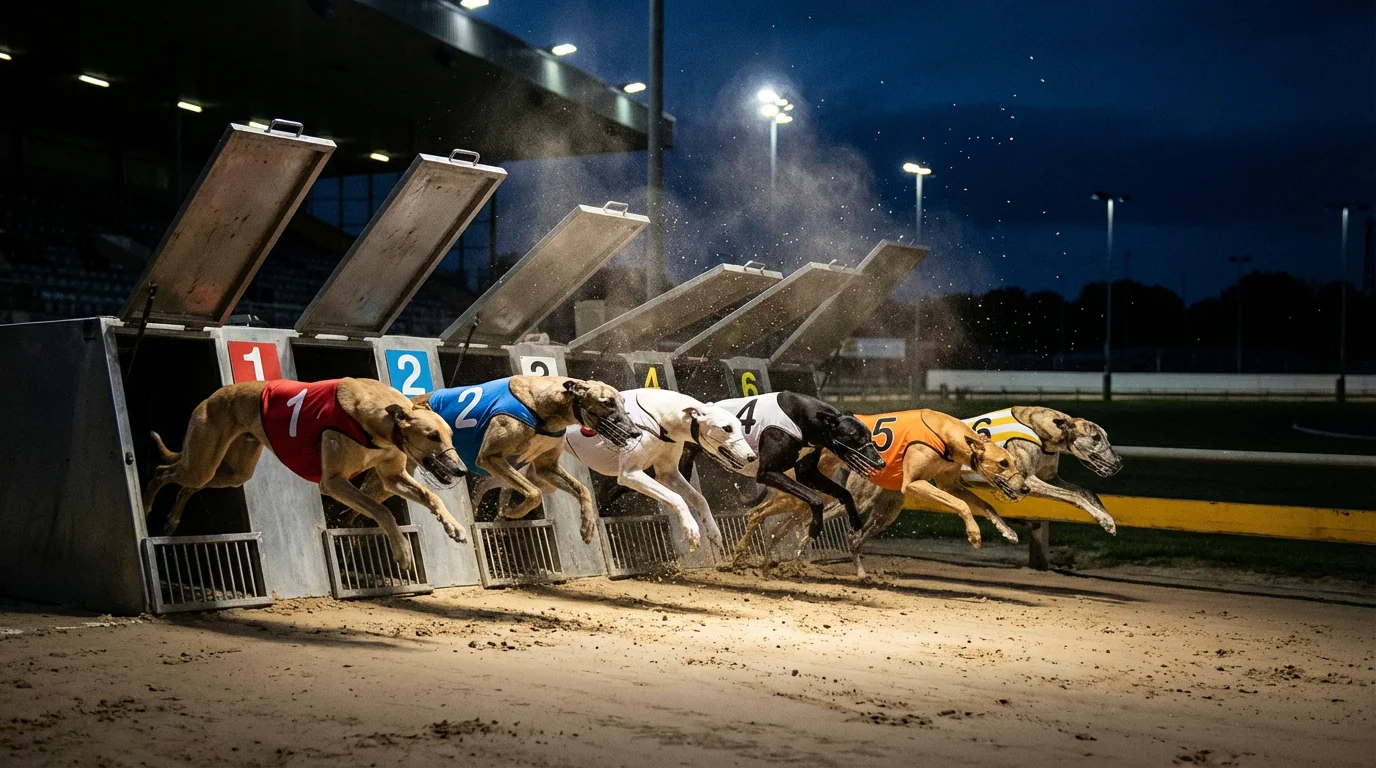
Six traps, 500 metres, 30 seconds. And weeks of preparation come down to one bend. The Derby final is a single race, but it carries the weight of everything that preceded it — months of ante-post speculation, six weeks of competitive racing, dozens of eliminated dogs, and a betting market that has been narrowing and sharpening since the first-round draw was made. The six finalists are the survivors, and the race itself is often decided by factors that transcend pure form: the trap draw, the first-bend crowding, the split-second interactions between dogs travelling at forty miles per hour in close proximity.
Final night at Towcester is typically a full evening of racing, with the Derby final as the centrepiece supported by a card of other races. The atmosphere is different from a regular meeting — higher attendance, more noise, a sense of occasion that even experienced racegoers notice. For bettors, the atmosphere is irrelevant except insofar as it can cloud judgment. The final is one more six-dog race to be assessed on the same criteria used throughout the tournament: form, sectionals, trap draw, running style, and trainer preparation.
The final trap draw is conducted after the semi-finals, and it is the last major variable to enter the equation. A dog that has led from the front in every previous round but draws trap six in the final faces a fundamentally different challenge. A closer that struggled from an inside draw in the semis might find trap five or six liberating. The draw reshuffles expectations one last time, and the final-night odds are set — and reshaped — in the hours between the draw and the off.
Most Derby finals are won by a dog that secures a strong position through the first bend and sustains it down the home straight. The track geometry at Towcester rewards clean early running and punishes dogs that get caught in traffic on the bends. First-bend position is not destiny — closers have won the Derby — but it is the single most important moment in the race. The dog that leads into the first turn wins the final more often than any other factor would predict, and every assessment of the final should start with the question: which dog is most likely to lead through that bend?
Key Dates and Schedule for the 2026 Derby
The 2026 Derby is scheduled for Towcester, with the final set for early June. The precise dates for each round are confirmed by the GBGB and Towcester Racecourse in the months before the competition, typically by February or March. The usual cadence runs first-round heats in late April, with subsequent rounds spaced at roughly weekly intervals through May, culminating in the semi-finals and final in June.
For ante-post punters, the key scheduling dates are: the entry deadline, which determines the full field and enables the first-round draw; the first-round draw itself, which assigns dogs to specific heats; and the semi-final draw, which reshapes the market for the final time before the conclusion. Each of these dates triggers a round of market adjustment, and the windows between them are where the sharpest betting opportunities tend to appear.
The supporting race programme on final night typically includes graded races and a consolation event for dogs eliminated in the semi-finals. These supporting races have their own betting markets and can provide additional opportunities for punters who have been tracking the wider field throughout the tournament. A dog that missed the final by a narrow margin in a strong semi-final heat may be excellent value in a consolation race against weaker opposition.
Check the GBGB and Towcester Racecourse websites for confirmed dates and the full race programme as the 2026 Derby approaches. Entry lists and draw announcements are typically published on these platforms first, giving punters who monitor them directly a small but useful timing advantage over those who wait for the information to filter through bookmaker sites and racing media.
The Tournament Is the Market
Every round changes the picture. The punter who tracks the whole tournament has the sharpest edge. From the first heat in April to the final in June, the Derby’s betting market is a moving target — and the movement is the opportunity. The ante-post prices that looked correct in February are obsolete by the time the first-round heats provide actual Towcester data. The first-round standout that shortened to 4/1 may drift again if a tough quarter-final draw or a poor run in the third round reveals a weakness that was not visible earlier.
The punters who profit from the Derby are the ones who engage with the tournament as a whole, not the ones who show up for the final and try to pick a winner from a six-dog field with thirty seconds of viewing time. The structure of the competition is designed to produce a worthy champion, but it is also designed — inadvertently — to reward the bettor who treats each round as both a race to bet on and a source of information for the rounds to come. The tournament is the market. Follow it from start to finish, and the market will show you where the value is.