Best Greyhound Betting Sites – Bet on Greyhounds in 2026
Loading...
The Favourite’s Record in the Derby Final Is Worse Than You Think
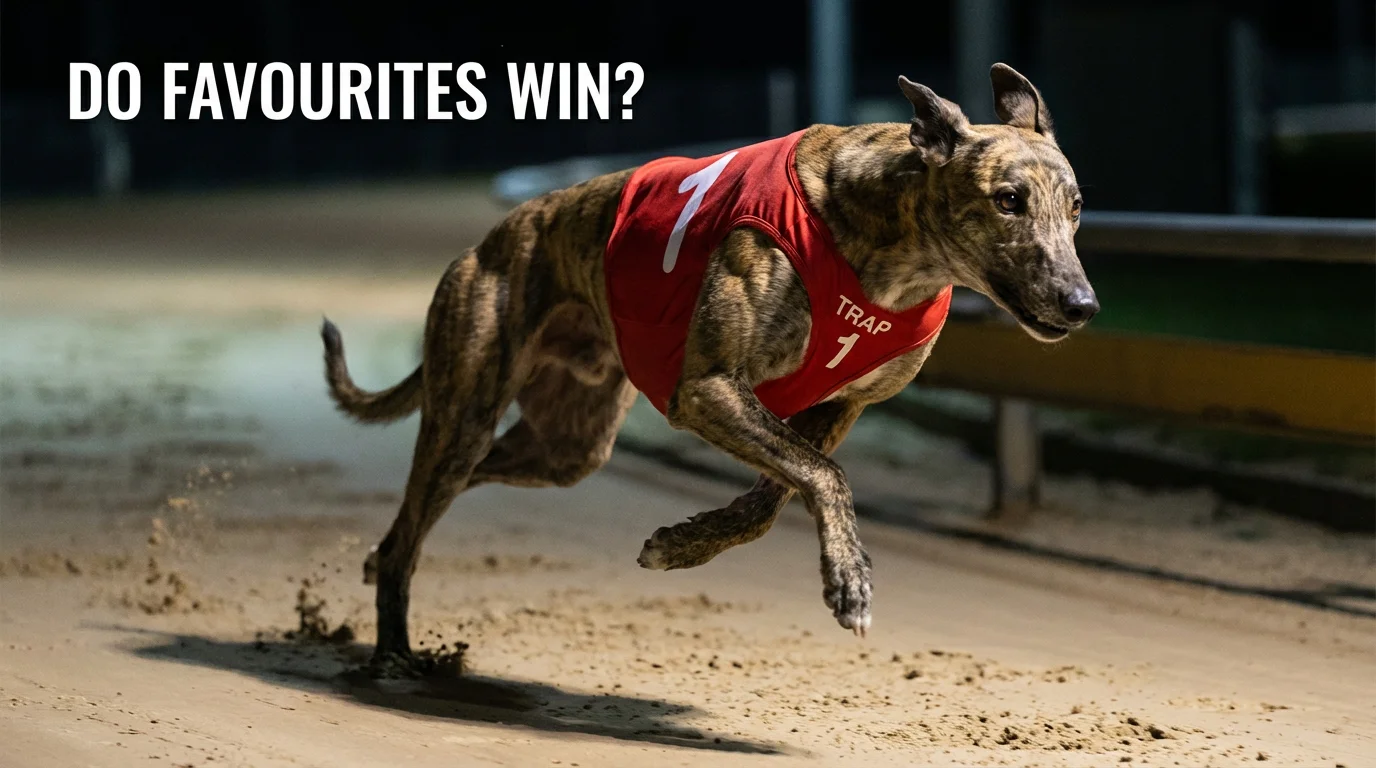
Only two favourites have won the Derby final in the last sixteen years. That statistic alone should give any punter pause before backing the market leader on final night. The greyhound that the betting public considers most likely to win the biggest race in British dog racing has, over an extended period, failed to deliver far more often than it has succeeded.
This isn’t a small sample or a statistical quirk. The Derby final is run once a year, every year, and the favourite — the dog with the shortest odds at the off — has an established record of underperformance that is consistent enough to represent a genuine pattern. The market gets it wrong in the Derby more often than in standard racing, and the reasons for that are structural rather than random. Understanding why the favourite fails so frequently is the starting point for a smarter approach to Derby betting.
This article examines the historical data, identifies the factors that make the Derby uniquely hostile to favourites, and suggests where the value lies if the market leader isn’t the answer.
Historical Favourite Strike Rate in Derby Finals
Since 1985, backing every Derby favourite to level stakes would have produced a significant loss. The exact figure depends on the period you choose and the starting prices used, but the direction is unambiguous: the favourite loses money for the bettor over the long run. This stands in contrast to favourites in standard graded racing, where the market leader wins frequently enough — roughly 30-35% of the time across UK tracks — to produce a near-breakeven or modestly profitable return at SP.
In the Derby final specifically, the favourite’s strike rate drops below that baseline. Over the past four decades, the favourite has won the final roughly once in every five or six runnings. The implied probability at typical favourite prices — between 2/1 and 7/2 — suggests the market expects the favourite to win 22-33% of the time. The actual win rate falls short of that expectation, which means the favourite is systematically overpriced for the Derby final.
The data becomes more stark when you examine the margins. Favourites that lose the Derby final don’t always finish second or third — many finish mid-pack or worse, beaten by several lengths. This isn’t the pattern of a dog that was unlucky or caught on the line. It’s the pattern of a dog whose odds didn’t reflect the true difficulty of winning a six-dog final in a knockout competition where the trap draw, running lines, and first-bend traffic can undo even the best dog in the field.
The longest-priced Derby winner in recent memory was Astute Missile in 2017 at 28/1 — a dog that few had seriously fancied for the title earlier in the competition. Other surprise winners at double-figure prices have recurred often enough to confirm that the Derby is a race where outsiders have a genuine chance, and that chance is consistently underestimated by the market. The favourite carries the public’s money but not the public’s best interests.
Level-stakes backing of the second favourite over the same period produces a better return, and the third favourite has also outperformed the market leader in many analyses. This suggests that the market is broadly correct about which dogs are competitive but consistently wrong about how much to concentrate its confidence on the top pick.
Why Favourites Underperform in the Derby
Six rounds of attrition, unpredictable trap draws, and one bad bend. The Derby final isn’t like any other greyhound race the favourite has won to reach that point. The dog that arrives at the final as market leader has typically won four or five races in succession at Towcester, each time against quality opposition, and the market rewards that consistency with a short price. What the market doesn’t adequately price is the accumulated risk that the final represents.
The trap draw is the most obvious disruptor. In the heats and semi-finals, the draw rotates and a good dog might get a favourable position in most rounds. The final draw is fixed, and a favourite drawn in Trap 5 — historically the weakest position at Towcester — faces a structural disadvantage that its form figures can’t overcome by effort alone. The market adjusts for the draw, but usually not enough. A favourite at 5/2 from Trap 3 might be fairly priced; the same dog from Trap 5 at 3/1 might still be too short.
Physical attrition is the second factor. By the time the final comes around, every dog has been racing weekly for five or six weeks. The favourite, often the dog that has been running hardest and winning most emphatically, has absorbed the most cumulative stress. Greyhounds don’t communicate fatigue the way humans do — a dog can look sharp in the parade ring and underperform by three lengths because of micro-fatigue in its legs that isn’t visible to the eye. The market prices what it can see; it can’t price what it can’t.
The third factor is the competitive compression of the final itself. By round six, every surviving dog is a proven performer at the venue. The spread of ability in the final is far narrower than in a first-round heat, which means the favourite’s superiority — if it exists at all — is measured in fractions of a second rather than comfortable margins. In a race where the difference between first and fourth might be half a second, the favourite’s edge is thinner than its price implies.
Where the Value Lies If Not With the Favourite
Second and third favourites in the Derby have a far better ROI over time. The historical data consistently shows that the value in the Derby final sits in the 4/1 to 10/1 range — dogs that the market rates as competitive but not dominant. These are the runners that have qualified strongly, often with a semi-final performance that suggests they’re peaking at the right moment, but haven’t attracted enough public money to compress their price below fair value.
The profile of a Derby value bet tends to follow a pattern. Look for a dog that won its semi-final impressively from a moderate draw — this demonstrates the ability to overcome adversity, which is the defining skill of the final. Look for improving sectional times through the competition, particularly a strengthening run-home split that suggests the dog is getting fitter rather than tiring through the rounds. And look at the trainer’s Derby record: kennels that have placed dogs in previous finals understand the preparation demands of a six-week competition, and that experience translates into better final-night performance.
Dogs at 8/1 and longer represent more speculative plays, but they win the Derby often enough that ignoring them entirely is a mistake. The key differentiator at big prices is the trap draw. A 10/1 shot drawn in Trap 3 at Towcester, with strong early pace and course form through the competition, is a qualitatively different proposition from a 10/1 shot drawn in Trap 5 with a wide running style and no course experience before Round 1. The price is the same, but the underlying probability is not.
Each-way betting becomes particularly attractive in the Derby final’s value zone. A dog at 8/1 with a genuine chance of hitting the first two represents a strong each-way position — the place portion at 2/1 (quarter odds) provides a return even if the dog doesn’t win, and the full each-way payout on a winner at that price is substantial. The Derby final is one of the rare races where each-way at medium prices consistently outperforms straight win bets on the favourite.
Assessing the 2026 Derby Favourite
The market has its pick. Here’s how to assess whether the price is right. The 2026 Derby season brings its own set of contenders, and by the time the ante-post market opens, one dog — or a small group — will be installed at the head of the betting. Before you back or oppose the favourite, run through a structured checklist.
First, consider the trainer. Has this kennel won or placed in the Derby before? A trainer with Derby final experience understands the specific demands of a six-round competition at Towcester — the travel, the weekly racing, the fitness management. Trainers without that experience may have the best dog on form but lack the campaign knowledge to deliver it at peak fitness on final night.
Second, assess the dog’s Towcester form. A favourite built on performances at other tracks carries more risk than one with proven course form. If the market leader has already trialled or raced at Towcester and posted strong sectionals over 500 metres, that’s a genuine positive. If its entire body of form comes from different circuits, the course adjustment introduces uncertainty that the market may not be pricing.
Third, look at the price itself. Is the favourite at 2/1 or 7/2? At 2/1, the implied probability is 33%, which — given the historical favourite strike rate of roughly 17-20% in the final — represents poor value. At 7/2, the implied probability drops to 22%, which is closer to realistic but still likely overestimates the favourite’s chances in a competitive six-dog field. The shorter the favourite’s price, the worse the value, because the historical data says the favourite wins less often than the market expects.
The Market Is Usually Right — Except in the Derby
The Derby’s knockout format creates chaos that flat-track form can’t predict. In a standard one-off race, the favourite is the market’s best estimate of the most likely winner, and that estimate is usually reasonable. But the Derby final isn’t a standard race. It’s the culmination of six weeks of elimination, physical stress, changing trap draws, and accumulated variables that compress the ability gap between the six surviving dogs to almost nothing.
The favourite is usually a good dog. Often the best dog. But the best dog doesn’t always win the Derby, and the historical record makes that abundantly clear. If your approach to the Derby final is to automatically back the market leader, you’re swimming against a current of data that says the value lies elsewhere. Look wider. Look at the 5/1 to 10/1 range. Look at the dog with the right draw, the right sectionals, and the right trainer. The favourite gets the attention. The winner often doesn’t.