Best Greyhound Betting Sites – Bet on Greyhounds in 2026
Loading...
The Same Dog at Three Different Prices
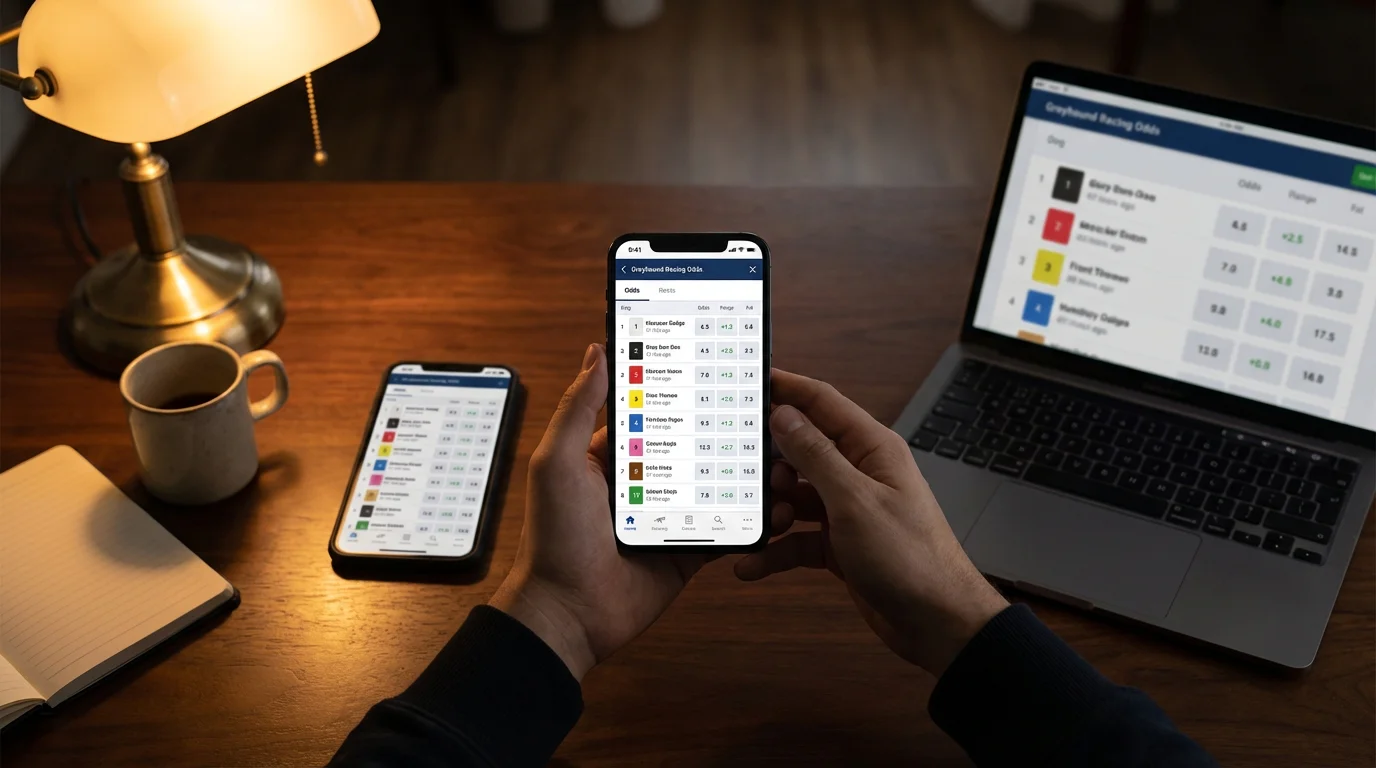
Odds vary between bookmakers. Checking more than one is the easiest edge in betting. Open three different bookmaker apps before a Derby heat and you’ll see the same dog quoted at three different prices — perhaps 7/1 at one, 13/2 at another, and 8/1 at a third. The dog’s chance of winning hasn’t changed. The only thing that’s different is how much you get paid if it does. Backing that dog at 8/1 instead of 13/2 increases your return by roughly 23% for no additional risk, no additional analysis, and no additional effort beyond looking at a second screen.
Price comparison is the lowest-effort, highest-impact habit a greyhound bettor can develop. It requires no form knowledge, no sectional analysis, no understanding of trap bias. It simply requires the discipline to check more than one source before placing a bet. Yet the majority of greyhound punters don’t do it — they have one bookmaker account, they bet at whatever price is offered, and they leave money on the table every single time.
Why Odds Comparison Matters in Greyhound Racing
A 10/1 at one bookmaker and 8/1 at another — that’s a 25% difference in return. On a ten-pound bet, the difference is twenty pounds of pure profit. Over the course of a Derby season, or a year of regular greyhound betting, those differences compound into a significant sum. The punter who consistently takes the best available price and the punter who always bets with the same bookmaker can make identical selections and have very different results at the end of the year.
Greyhound markets are less efficient than horse racing markets, which makes price discrepancies more common and more persistent. Horse racing attracts deeper liquidity, more professional money, and more competitive pricing between operators. Greyhound racing, with its smaller betting volumes and less public scrutiny, sees wider price variations that take longer to close. A dog might be 6/1 at one bookmaker for an hour before the price aligns with the 5/1 available elsewhere. That hour is your window.
The impact compounds when you’re betting at higher odds. At short prices — 2/1 or 5/4 — the difference between bookmakers is often a fraction: 2/1 versus 15/8. That matters, but the absolute gap is small. At 10/1 and above, the gaps widen. A dog at 10/1 at one bookmaker and 12/1 at another represents two extra units of return per pound staked. In the Derby ante-post market, where prices can reach 33/1 or 50/1, the variations between operators can be dramatic — differences of five or ten points of odds on the same dog.
Even for punters who consider themselves casual, the habit of checking two or three prices before betting pays for itself immediately. You don’t need accounts with a dozen bookmakers. Three is enough to capture the majority of available value. The time investment is thirty seconds per bet — the time it takes to open a second app and compare the number.
Odds Comparison Tools and How to Use Them
Oddschecker and similar aggregators show you every price at a glance. These platforms pull live odds from multiple bookmakers and display them side by side for each runner in a race. You type in the meeting and race, and the screen shows you every dog’s price across ten or more operators. The best price for each selection is highlighted, making it immediately obvious where to place your bet for maximum return.
For greyhound racing, odds comparison tools cover most BAGS meetings and all major evening cards. Coverage of individual races is updated in near real-time as bookmakers adjust their prices, though there can be a short delay between a price change at the bookmaker and its appearance on the aggregator. For fast-moving greyhound markets, particularly in the minutes before a race, the displayed price may be slightly behind the live price — always confirm the actual odds on the bookmaker’s own site before placing the bet.
The most effective way to use comparison tools for Derby betting is to check the ante-post market across operators at regular intervals. Ante-post odds move less frequently than race-day prices, which means discrepancies between bookmakers can persist for days. A dog at 20/1 at one bookmaker and 25/1 at another will stay that way until one of them adjusts — giving you plenty of time to take the better price. Building a habit of checking the ante-post comparison once a day during the Derby build-up takes minimal effort and can identify value that would be invisible if you were only looking at a single operator.
Beyond the headline odds, comparison tools sometimes show additional information: whether each bookmaker offers Best Odds Guaranteed, whether enhanced odds promotions are running, and whether extra place terms apply. These secondary details can affect the real value of a bet as much as the headline price. A dog at 8/1 with BOG at one bookmaker is a better bet than the same dog at 9/1 without BOG at another, if the SP drifts to 12/1.
Best Odds Guaranteed on Greyhound Races
BOG protects your early price if the SP is higher. Most major UK bookmakers offer Best Odds Guaranteed on BAGS greyhound meetings, and it’s one of the most valuable features available to greyhound bettors. The mechanic is simple: you take an early price, and if the starting price at the off is higher, you’re paid at the SP instead. If the SP is lower, you keep your original price. You always get the better of the two.
For greyhound racing, where prices can shift significantly in the final minutes before a race, BOG removes the timing risk from early betting. A dog you back at 5/1 in the morning might drift to 7/1 by the off because the favourite shortens and the rest of the market adjusts. With BOG, you’re paid at 7/1 — an automatic improvement that costs you nothing. Without BOG, you’d have been locked in at 5/1 and missed the drift entirely.
Not all greyhound meetings qualify for BOG. Some bookmakers restrict it to BAGS meetings only, excluding independent tracks and certain evening fixtures. Others offer it across the board but with limits on maximum payout. Check the terms for each operator before assuming your Derby bet qualifies — the major BAGS cards that host Derby heats are almost always covered, but it’s worth confirming.
The strategic use of BOG is to take early prices with confidence. If your form analysis identifies a dog you want to back, take the best available price as soon as your research is complete. BOG ensures that if the market moves against you — if the dog drifts because other punters don’t share your view — you benefit from that drift rather than being disadvantaged by your early commitment. It turns an early price into a floor rather than a fixed position.
When to Lock in a Price vs Wait for SP
Early prices suit informed bets. SP suits reactive ones. The decision of when to take a price depends on how much conviction you have in your selection and how much information the market has yet to absorb.
If you’ve analysed the form, assessed the trap draw, and formed a clear opinion before the market opens, taking an early price makes sense. You’ve done the work; the price reflects the current market’s view. If your analysis is correct and the market later adjusts in your favour — the dog shortens — you’ve locked in a price that’s better than what’s available to latecomers. If the dog drifts, BOG protects you. Either way, the early price was the right decision at the time.
Waiting for SP is appropriate when you don’t have a strong pre-race opinion and prefer to let the market settle before committing. SP is the final price at the moment the traps open, reflecting all the money that’s been bet throughout the day. It incorporates late information — market moves, kennel confidence, late scratchings — that an early price doesn’t capture. For races where you’re unsure about your selection or where the market is volatile, SP avoids the risk of taking a price that’s worse than what you’d have got had you waited.
For the Derby specifically, the ante-post phase rewards early pricing almost by definition — the whole point of ante-post betting is to take a price before the market tightens. On race day, the choice is more nuanced. For heats and semi-finals where you have strong form data, early prices with BOG are usually the better approach. For the final itself, where the market is deep and the pricing is sharp, the difference between an early price and the SP may be small enough that timing matters less than selection.
Price Discipline Compounds Over Time
Consistently taking the best price is the simplest profitable habit in betting. It doesn’t require brilliance. It doesn’t require insider knowledge. It requires accounts with three bookmakers, thirty seconds of comparison before each bet, and the discipline to always click the button where the number is highest. Over a season of greyhound betting, that discipline adds percentage points to your return — points that no amount of form analysis can replace if you’re consistently leaving them on the table.
Think of it as compound interest in reverse. Every bet placed at the second-best price is a small leak. Over ten bets, the leak is barely noticeable. Over a hundred, it’s measurable. Over a year of regular greyhound betting, it’s the difference between a modest profit and a modest loss for punters whose selection ability is otherwise identical. Price discipline doesn’t make bad selections good, but it makes good selections better — and in a sport where the margins are thin, that improvement is often all you need.