

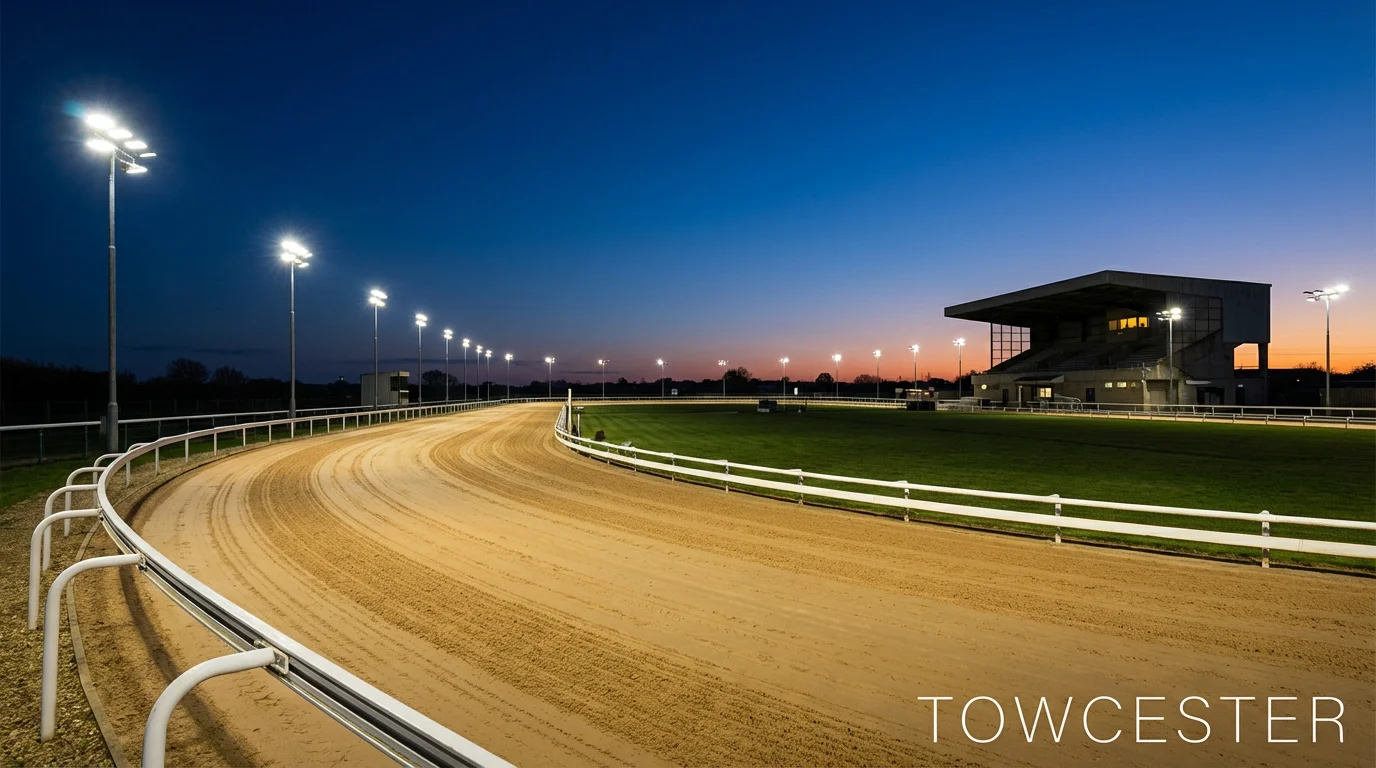
The Home of the Greyhound Derby
Towcester isn’t just a venue — its layout shapes the entire Derby narrative. Every dog that competes in the English Greyhound Derby runs the same 500 metres of sand track in rural Northamptonshire, negotiates the same four bends, and faces the same demands at the same points of the circuit. The track is not a neutral container for the race. It’s an active participant, rewarding certain running styles and punishing others in ways that are consistent, measurable, and directly relevant to how you bet. Find more track guides at greyhoundderbyodds.
Towcester Greyhound Stadium sits adjacent to the town’s horse racing course, sharing the broader estate but operating as a separate facility purpose-built for greyhound racing. It became the permanent home of the Derby after the closure of Wimbledon in 2017 and, following a brief period of financial difficulty and a temporary move to Nottingham, was re-established as the Derby venue. The track has hosted the competition long enough now that a substantial body of race data exists — enough to identify genuine track biases, surface patterns, and the kind of course-specific form that separates Derby contenders from pretenders.
If you’re betting on the Derby, understanding Towcester is not optional. It’s the starting point for every selection decision, from the opening heats through to the final.
Track Layout — Distance, Surface, and Bend Configuration
The Derby is run over 500 metres on sand, with four bends and a standard six-trap start. That’s the headline specification, but the detail underneath it is what matters for betting. Towcester is a larger circuit than most UK greyhound tracks, and its geometry produces racing dynamics that differ meaningfully from tighter venues like Romford or Central Park.
The run from the traps to the first bend is relatively long compared to smaller circuits. This matters because it gives dogs more time to establish their racing line before the field converges at the turn. At a tight track, the first bend arrives quickly and the trap draw dominates — inside dogs have a short run to the rail and outside dogs are immediately disadvantaged. At Towcester, the longer run to the first bend allows faster-breaking dogs from middle and outside traps to compete for position, which moderates the inside-trap bias seen elsewhere. It doesn’t eliminate it — inside traps still carry a geometric advantage — but the effect is less extreme.
The sand surface at Towcester is typical of modern UK greyhound tracks. It provides a consistent running surface that’s maintained between meetings, but its speed varies with moisture content. Dry conditions produce faster times; wet sand slows the surface and increases the physical demands on the dogs. Surface speed on any given night is reflected in the overall times across the card, which is why comparing a dog’s time from one meeting to another requires knowing the conditions on each occasion.
The four bends are configured as sweeping left-hand turns. The first bend is the most critical — this is where the race is usually decided, as the field narrows from six-wide to a racing order that rarely changes significantly through the remaining three turns. The third bend is the second pinch point, where dogs on the outside lose ground if they haven’t established position by that stage. The second and fourth bends are less decisive tactically but still penalise dogs running inefficient lines.
The finishing straight is long enough that strong closers can make ground on the run-in, but not long enough to overcome a significant deficit. A dog two or three lengths behind the leader at the final bend might close to within half a length but rarely overtakes. The finishing straight rewards dogs that maintain pace through the final turn, not those that accelerate late from deep positions. This is a track where front-runners and mid-pack dogs with sustained speed have a structural advantage over out-and-out closers.
Known Track Biases and Bend Behaviour
The first and third bends catch out dogs without course knowledge. This is the most consistent finding in Towcester’s race data: dogs running at the track for the first time, or without recent course form, underperform relative to their ability, and the effect is concentrated at those two bends.
The first bend bias is a function of the track’s geometry. The sweeping left-hand turn requires dogs to adjust their stride and lean into the bend at speed. Dogs familiar with Towcester negotiate this instinctively; newcomers often lose half a length by running a slightly wider line or checking their stride at the entry to the turn. In a tight field, that half-length is the difference between leading into the back straight and being caught in traffic.
The third bend is where fatigue begins to interact with track knowledge. By this point in a 500-metre race, dogs have covered roughly 350 metres and the pace is telling. Dogs that know the track conserve energy through the second and third turns, maintaining an efficient line close to the inside rail or holding their wide position without drifting further out. Dogs without that familiarity tend to run less efficient lines — slightly wider, slightly more erratic — and the cumulative ground lost through three turns compounds into a meaningful disadvantage by the time they hit the finishing straight.
Trap-position bias at Towcester is moderate compared to smaller circuits. Traps 3 and 4 tend to overperform, benefiting from a clear run to the first bend without the rail-side congestion that can affect Traps 1 and 2. Trap 5 consistently underperforms, while Trap 6 is viable for wide runners with strong early pace. The data shifts slightly depending on whether you’re looking at sprint distances or the 500-metre Derby distance, but the general pattern holds: middle traps are favoured, extremes are more dependent on running style.
For Derby bettors, course form at Towcester is one of the strongest predictive indicators available. A dog entering the Derby with three or four recent runs at Towcester — even in non-Derby races — has a measurable advantage over one making its track debut in Round 1. Many leading trainers exploit this by running their Derby entries at Towcester in the weeks before the competition begins, building course familiarity alongside race fitness.
How Weather Affects Towcester’s Sand Surface
Heavy rain makes the sand heavier. Dry spells speed it up. Both shift the market, and both should shift your assessment of the form.
Towcester’s sand surface is maintained to a consistent standard, but moisture content varies with the weather and can change significantly between meetings — or even during a single evening’s card. After heavy rain, the sand retains water, becoming denser and slower. Dogs need to work harder to maintain speed, and finishing times across the card will be several tenths slower than on a dry night. This affects all dogs, but it affects them unequally. Heavier, more powerful dogs tend to cope better with a slower surface than lighter, speedier types that rely on a fast track to produce their best times.
Dry, warm conditions have the opposite effect. The sand dries out, becomes lighter, and runs faster. Times improve across the board, and the track favours dogs with natural speed over those that grind out results through stamina. In extended dry spells, the surface can become quite quick — and dogs that posted moderate times in wet conditions earlier in the competition may suddenly look like different animals when the track speeds up.
For Derby betting, weather awareness matters most when you’re comparing form from different rounds. A dog that ran 29.50 in a Round 2 heat on a rain-affected surface and 29.20 in a Round 4 heat on a dry track hasn’t necessarily improved by three-tenths. The track did most of that work. The sectional breakdown — particularly the run-home time — is more stable across different surface conditions than the finishing time, which is another reason to prioritise sectionals over raw clock when assessing Derby form at Towcester.
Attending the Derby at Towcester
Towcester is located in south Northamptonshire, roughly 70 miles north-west of London. It’s accessible by car via the M1 and A43, and the nearest train station is Northampton, about 15 miles away. On Derby night, the track operates at near capacity, and the atmosphere inside the stadium is markedly different from a standard midweek meeting. It’s the one night of the year when greyhound racing in Britain feels like a proper sporting event rather than a niche pursuit.
The stadium offers a mix of general admission and hospitality packages. General admission gives you access to the trackside viewing areas and the main grandstand. Hospitality options typically include private boxes, restaurant dining, and package deals that bundle food, drinks, and prime viewing positions. These sell out well in advance for the final, so early booking is advisable if you want anything beyond standard entry.
For bettors attending in person, the on-track bookmakers and Tote facilities operate alongside digital betting. You can back your selections with the trackside bookmakers at their displayed prices or use the Tote pool. The advantage of being on track is access to the parade ring, where you can assess the dogs’ condition — weight, coat, demeanour — before each race. It’s a data point that screen-based punters don’t get, and experienced on-track bettors consider it valuable, particularly for the later rounds when every small advantage counts.
Race nights at Towcester typically begin in the early evening, with the Derby final card running across several races. The final itself is the headline event, but the supporting card includes consolation races and open events that offer their own betting opportunities. Plan for a full evening. Parking is available on-site and the surrounding area is rural, so arranging transport in advance — particularly for the return journey — is sensible.
Know the Track, Know the Derby
Course form is the most undervalued asset in Derby betting. The trap draw gets attention. The early-pace sectionals get analysed. But the simple question of whether a dog has run at Towcester before — and how it handled the bends, the surface, and the specific demands of a 500-metre race on this particular circuit — is often treated as secondary. It shouldn’t be. Also read our UK greyhound racing tracks betting guide.
Towcester is not a generic venue. Its layout, its surface behaviour, and its bend geometry create a racing environment that rewards specific qualities: course knowledge, efficient bending, sustained pace, and the ability to cope with varying surface conditions across a six-week competition. Every dog in the Derby runs the same track, but they don’t all run it equally well. The ones that know it best — or adapt to it fastest — have an advantage that no amount of raw speed from a different circuit can reliably overcome.
