

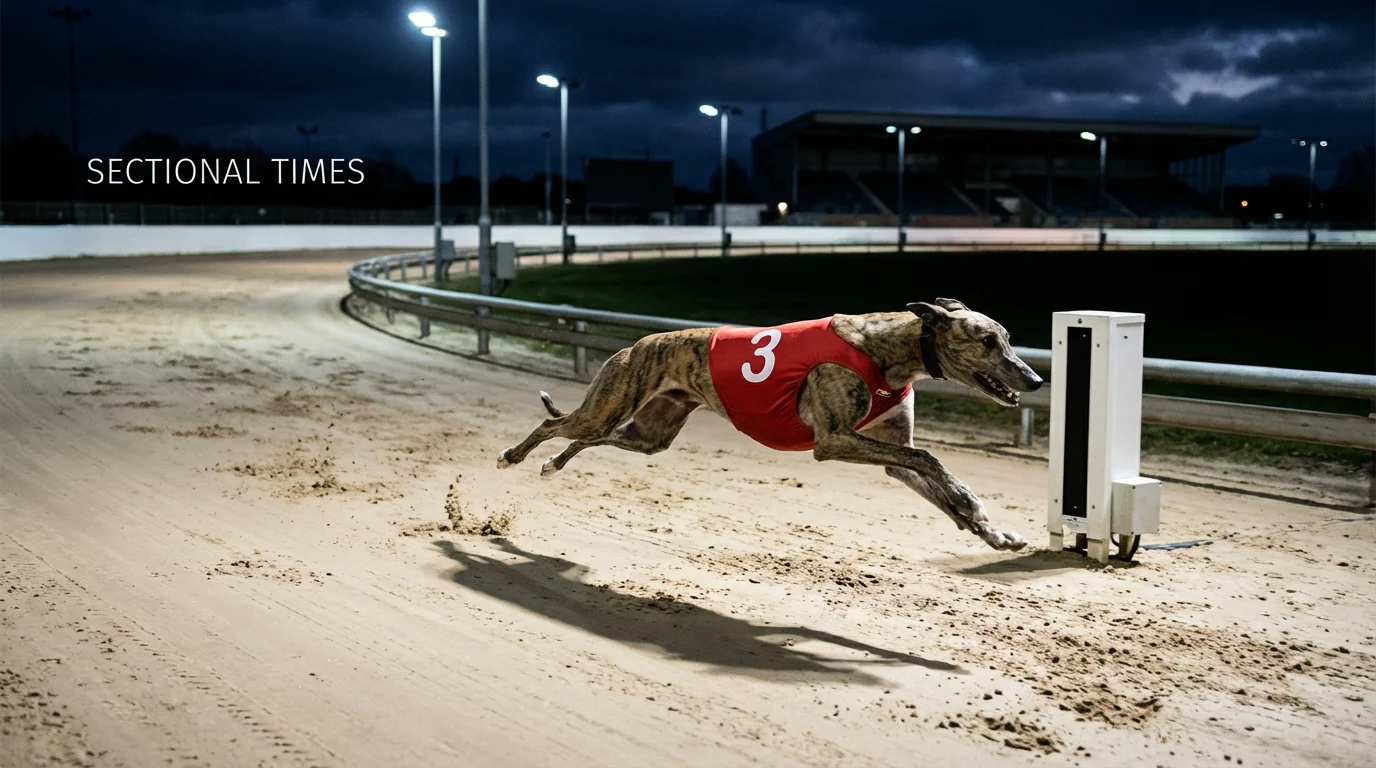
Why Finishing Time Alone Is Misleading
A fast time on a fast track means nothing without context. Every greyhound race produces a finishing time — the clock from trap opening to the dog crossing the line — and most punters use that number as their primary performance indicator. A dog that ran 29.10 over 500 metres at Towcester last week looks faster than one that clocked 29.45 at the same track a fortnight earlier. Simple comparison, obvious conclusion. And often, completely wrong. Get more race analysis at greyhoundderbyodds.
Finishing time is influenced by factors that have nothing to do with individual ability. Track surface speed varies with weather and maintenance — a wet sand track runs slower than a dry one, sometimes by several tenths of a second. The pace of the race matters too: a dog that leads from trap in an uncontested front-running display will often clock a faster time than a stronger dog that was caught in traffic at the first bend and had to fight for position through three turns. The finishing time records the race’s outcome, not its character.
Sectional times solve this problem by splitting the race into segments. Instead of one number that tells you how long the whole thing took, you get two or three numbers that show how the race unfolded — where the dog gained ground, where it lost it, how fast it started, and how well it sustained its speed to the line. For Derby betting, where you’re comparing dogs that have all raced over the same course and distance in successive rounds, sectionals are the most precise tool available for separating genuine contenders from flattered performers.
What Sectional Times Are and How They’re Measured
Sectionals split a race into segments — usually trap-to-first-bend and first-bend-to-finish. The exact measurement points vary by track, but the principle is consistent across all GBGB-licensed venues: electronic timing equipment records the dog’s time at specific markers around the circuit, producing a split for each segment of the race.
At Towcester over 500 metres, the standard sectional breakdown gives you a time from the trap to the first bend (the early-pace sectional) and the time from the first bend to the finish line (the run-home time). Some timing systems record additional splits at each bend, but the two-part split — early and late — is the most widely published and most useful for betting purposes.
The early-pace sectional measures how quickly the dog breaks from the trap and covers the ground to the first turn. This is the number that tells you about a dog’s natural break speed, its reaction to the mechanical hare, and how effectively it transitions from the straight run out of the boxes into the first bend. A fast early-pace sectional doesn’t guarantee a fast overall time, but it correlates strongly with race position at the crucial first bend — and in greyhound racing, first-bend position is the single strongest predictor of the final result.
The run-home time measures everything from the first bend onwards: how well the dog negotiates the remaining bends, whether it sustains its pace, and how strongly it finishes. A dog with a moderate early-pace sectional but a fast run-home time is typically a closer — one that recovers from a slow start and finishes strongly. A dog with a blazing early sectional but a slow run-home time is a confirmed front-runner that fades if challenged. Both profiles can win races, but they do it differently, and the sectionals reveal which type you’re dealing with.
Sectional data is published in race results by the GBGB and appears on most major greyhound form databases. Not all punters use it, which is precisely why it’s valuable. The finishing time is the headline number; the sectionals are the paragraph underneath that explains what the headline actually means.
Early Pace — The Single Most Important Number
Dogs that break fast dominate greyhound racing. The sectional proves it. Across UK tracks, the dog that leads at the first bend wins the race more often than any other single factor would predict — somewhere between 35% and 45% of the time, depending on the venue and distance. In a six-dog race where a random winner has a 16.7% chance, that’s a massive overperformance, and it’s driven almost entirely by early pace.
The trap-to-first-bend sectional quantifies this advantage. At Towcester over 500 metres, a dog posting a fast early-pace split — say, sub-4.40 seconds to the first bend — is likely leading the field by the time it enters the turn. That lead translates into a clean racing line through the bend, freedom from interference, and the ability to dictate the pace for the rest of the race. The dogs behind it are either wide on the bend or bunched up on the rail, losing ground either way.
For Derby betting, early-pace sectionals are the first filter when assessing a heat or semi-final. Pull up the early-pace numbers from each dog’s recent races — ideally at Towcester, but any 500-metre race on sand provides a useful reference. Identify the fastest breaker in the field. Then check the trap draw: if the fastest breaker has an inside or middle draw, the combination of raw pace and a clean run to the bend makes it a serious threat regardless of its overall form figures.
Conversely, a dog with slow early pace drawn on the outside is facing a compounding disadvantage. It’s already behind the leaders before the first bend, and it has a wider route to cover. Over 500 metres, there’s time to recover — this isn’t a sprint — but the dog needs a strong run-home to compensate. The early-pace sectional tells you whether the dog is likely to be in front or behind at the point of the race that matters most. Everything else follows from that.
One nuance worth noting: early pace is partly influenced by trap performance. Some dogs break faster from certain trap positions due to their stance, reaction time, and the angle of the boxes. A dog that consistently posts sub-4.40 from Trap 1 might run 4.55 from Trap 5 because its break mechanics are disrupted by the wider starting position. When analysing early-pace sectionals, always note the trap the dog was drawn in for each recorded time. A fast sectional from an unfavourable trap is a stronger signal than the same time from a favourable one.
Run-Home Times and Stamina Indicators
A strong run-home time separates genuine stayers from dogs that tire. The run-home split — first bend to finish line — reveals the second half of the story that early pace begins. While the early sectional tells you where the dog was after the first bend, the run-home time tells you what happened next: did it maintain its speed, or did it fade? Did it close ground on the leaders, or lose more?
Over the Derby distance of 500 metres at Towcester, the run-home time is particularly informative because the race involves four bends and a long finishing straight. Dogs that lead through the first two bends but slow through the third and fourth produce a telling pattern: fast early sectional, slow run-home. This is the profile of a dog that may win comfortable heats against moderate opposition but will struggle against better dogs that sustain their speed deeper into the race. In the Derby final, where every dog is a proven performer, that fade pattern is exploitable.
The opposite profile — moderate early pace, fast run-home — describes a closer. These dogs are often further back at the first bend but gain ground steadily through the race, arriving at the finish line with momentum. Closers are undervalued in greyhound betting because the eye is drawn to the front-runner, and the form line records finishing position without showing how close the margin was on the run-in. A dog that finishes second, a length behind the leader, after making up four lengths from the back of the field has arguably run a stronger race than the winner. The run-home sectional makes that argument visible.
When comparing dogs for a Derby semi-final or final, look at the ratio between early pace and run-home time across their recent runs. Consistent dogs — those whose two splits are relatively stable from race to race — are more predictable and easier to position in a forecast or tricast. Dogs with volatile splits, fast one week and slow the next, carry more risk. They might produce a spectacular performance or a flat one, and the sectional history tells you that their output is less reliable than their best form suggests.
Using Sectionals to Compare Dogs Across Different Tracks
Comparing a Harlow time to a Towcester time is meaningless without sectional adjustment. Every UK track has different dimensions — the run from the traps to the first bend varies, the bend radii differ, the surface speed fluctuates, and the total distance may be measured slightly differently. A finishing time of 29.30 at one track is not equivalent to 29.30 at another. A dog posting that time at a small, tight track with fast sand has done something qualitatively different from a dog running the same clock at a larger, slower venue.
Sectionals help bridge this gap. While raw finishing times are track-specific and can’t be compared directly, the proportional breakdown of a race is more transferable. A dog that consistently produces 60% of its finishing time in the run-home section, regardless of track, is showing a racing profile — a strong closer that gains ground through the bends and finishes powerfully. That profile holds across venues, even when the absolute times differ.
For the Derby specifically, the most useful cross-track comparison comes from early-pace sectionals. If a dog’s first-bend split at Romford (a tight, short-run track) suggests it breaks in the top two at first bend, and the same dog’s splits at Nottingham (a bigger, more galloping track) show the same positional dominance, you can be confident that the dog’s early pace is genuine and will translate to Towcester — even though the raw sectional times at each venue are different numbers.
The adjustment becomes less necessary as the Derby progresses, because by Round 3 or 4, every remaining dog has multiple race times at Towcester over 500 metres. At that point, you’re comparing like with like: same track, same distance, same surface condition within a few days. The sectionals from the middle rounds of the Derby are the purest form data in all of UK greyhound racing, and the punters who use them have a material advantage over those who rely on finishing times alone.
The Stopwatch Inside the Stopwatch
Sectionals are the form reader’s edge — granular, underused, and publicly available. Every piece of data discussed in this article is published after every race at every GBGB-licensed track. There is no proprietary access required, no subscription to a secret database, no insider knowledge involved. The split times are sitting in plain sight, waiting to be put to work.
That’s the opportunity. While the majority of greyhound bets are placed on the basis of finishing times, recent form figures, and gut feeling about the trap draw, a sectional-based approach adds a layer of analysis that the market consistently underprices. It tells you not just what happened, but how it happened — whether a fast time was earned through sustained pace or gifted by an uncontested lead, whether a slow time masked a strong performance disrupted by early crowding, and whether a dog’s running profile suits the specific demands of the race ahead. Also read our best trap positions in greyhound racing.
Build sectionals into your Derby research from Round 1 onwards. Note each dog’s early-pace and run-home splits after every heat. Track consistency, improvement, and decline. By the semi-finals, you’ll have a dataset that covers every contender across multiple races at Towcester, all measured in identical conditions. That dataset is the closest thing to an edge that greyhound betting offers — and the price of entry is simply paying attention to the numbers that most people overlook.
