Each-Way Betting — Two Bets, One Slip
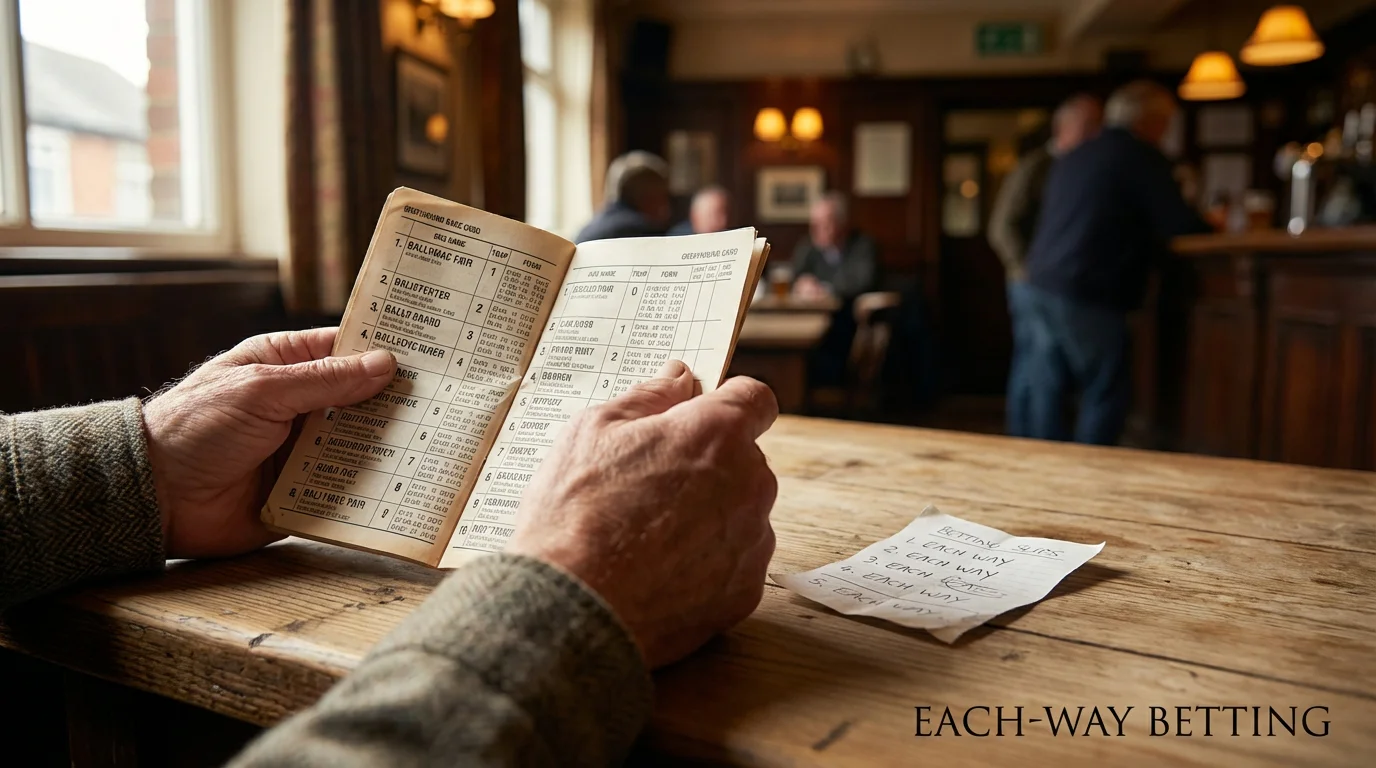
An each-way bet is two separate wagers, and most beginners don’t realise that. When you place a fiver each-way on a greyhound, you’re staking ten pounds — five on the dog to win, and five on it to place. If the dog wins, both bets pay out. If it finishes second (in a standard six-runner race), only the place part returns. If it finishes third or worse, you lose the lot. The “each-way” label makes it sound like a single, cautious bet. In practice, it’s a structured position with two distinct outcomes and a total stake that’s double what many punters expect. Find more bet type guides at greyhoundderbyodds.
Understanding this distinction matters because each-way betting is one of the most commonly used and most commonly misunderstood tools in greyhound racing. It’s neither a hedge nor a safety net by default — it’s a calculated bet that only offers value in specific situations. Used correctly, it turns a risky outsider into a position with multiple paths to profit. Used carelessly, it doubles your exposure on a dog that was overpriced to begin with.
In the context of the Greyhound Derby, each-way takes on additional significance. The Derby final is a six-dog race with place terms of 1/4 odds for first and second. That relatively tight field, combined with the elevated odds that the knockout format produces, creates conditions where each-way betting can be genuinely powerful — provided you understand the mechanics and pick your spots.
How Each-Way Works in a Six-Dog Greyhound Race
In a standard six-runner field, each-way pays at 1/4 odds for first or second. That’s the industry default for greyhound racing in the UK, and it applies to virtually every race you’ll encounter — heats, semi-finals, and finals alike. The terms mean that the place portion of your bet is settled at a quarter of the win odds.
Here’s how it breaks down mechanically. Suppose you back a dog at 8/1, staking five pounds each-way (ten pounds total). If the dog wins, your win bet returns five pounds times 8/1 = forty pounds profit, plus your five-pound stake back. Your place bet also pays, at 1/4 of 8/1 = 2/1, returning five pounds times 2/1 = ten pounds profit, plus your five-pound stake. Total return on a winner: sixty-five pounds from a ten-pound outlay.
If the dog finishes second, the win bet loses. The place bet pays at 2/1 (one-quarter of 8/1), returning fifteen pounds. You’ve staked ten pounds total, so the net profit is five pounds. Not spectacular, but you’ve turned a losing position into a modest gain. That’s the core appeal of each-way: it provides a return even when the dog doesn’t win, so long as it hits a place position.
If the dog finishes third or lower, both parts lose and the full ten-pound stake is gone. This is the scenario casual bettors tend to underestimate. A six-dog race with two paying places means there’s a 4-in-6 chance — roughly 67% — that neither part of your each-way bet returns anything. Each-way doesn’t reduce your downside as dramatically as it might appear. It softens the blow when you’re close, but it does nothing when you’re not.
Some bookmakers occasionally enhance place terms for the Derby final specifically, offering 1/4 odds for three places instead of two. When this happens, it shifts the value calculation significantly in the bettor’s favour. Keep an eye on promotional terms as the final approaches — they can turn a marginal each-way proposition into a strong one.
When Each-Way Offers Value in Greyhound Betting
Each-way shines when the field is open and no single dog stands out. In a competitive six-runner race where there’s no clear favourite — or where the favourite’s price is short enough to suggest the market sees vulnerability — placing an each-way bet on a mid-priced outsider can produce a better expected return than a straight win bet on the market leader.
The arithmetic is straightforward. Each-way value depends on the relationship between a dog’s true chance of placing and the place odds you’re being offered. If a dog is priced at 10/1, its place part pays at 2.5/1 (one-quarter of 10/1). For that place bet alone to be value, the dog needs to finish first or second more than once in every 3.5 attempts. In a genuinely open six-dog field, a 10/1 shot may well have a 25-30% chance of hitting a top-two finish — comfortably above the breakeven threshold.
Contrast that with a short-priced favourite at 6/4. The place odds are just 3/8 (one-quarter of 6/4). To justify the place part, the dog needs to finish first or second roughly 73% of the time. Even a strong favourite in greyhound racing rarely achieves that strike rate over multiple races. At short prices, the each-way bet is doing almost nothing for you — the place portion adds negligible value and doubles your stake on a dog that’s already giving you thin margins.
The optimal zone for each-way greyhound bets tends to fall between 5/1 and 20/1. Below 5/1, the place returns are too thin to justify the doubled stake. Above 20/1, the dog’s realistic chance of placing drops to a point where you’re better off just taking a small straight win bet and accepting the volatility. Within that 5/1 to 20/1 range, the relationship between place probability and place odds frequently produces genuine value, especially in high-quality fields like Derby heats and semi-finals.
Each-Way Derby Bet — Worked Example
Let’s run the numbers on a 10/1 each-way shot in the Derby final. You believe a dog has a realistic chance of hitting the frame based on its semi-final performance, trap draw, and early pace sectionals. The market has it at 10/1, suggesting an implied probability of around 9% to win. You disagree — you think the true win probability is closer to 12-15%, with a place probability of 30% or higher.
You stake ten pounds each-way, which means twenty pounds total: ten on the win, ten on the place.
Scenario one: the dog wins. Your win bet returns ten pounds at 10/1 = one hundred pounds profit, plus your ten-pound stake. Your place bet pays at 2.5/1 (quarter of 10/1) = twenty-five pounds profit, plus your ten-pound stake. Total return: one hundred and forty-five pounds. Net profit: one hundred and twenty-five pounds from a twenty-pound outlay.
Scenario two: the dog finishes second. Win bet loses (minus ten pounds). Place bet pays at 2.5/1 = twenty-five pounds profit, plus your ten-pound stake back. Total return: thirty-five pounds. Net profit: fifteen pounds. You’ve lost the race but made money on the position.
Scenario three: the dog finishes third to sixth. Both bets lose. Total loss: twenty pounds.
The expected value of this bet depends on how accurately you’ve assessed the probabilities. If the dog truly has a 13% win chance and a 30% place chance, the expected return per pound staked is positive. Run those numbers across twenty similar bets over a season and the each-way approach builds a meaningful edge — not from any single dramatic win, but from the accumulated place returns cushioning the losers and the occasional winner providing the real profit.
The worked example also illustrates a subtler point: the each-way structure rewards you disproportionately when the dog wins. That 10/1 winner doesn’t just pay the win portion — the place part pays too, effectively acting as a bonus on top. This asymmetry is what makes each-way attractive on mid-priced selections. The downside is capped at your total stake, the upside on a winner is amplified, and the place finishes provide partial recovery along the way.
Common Each-Way Mistakes to Avoid
Backing a short-priced favourite each-way is almost never profitable. The maths from the previous section tells the story — at short prices, the place portion adds virtually nothing except extra exposure. If you fancy the favourite, back it to win and save the place stake for a separate bet elsewhere on the card.
The second common error is treating each-way as a default on every race. Some punters place every bet each-way out of habit, regardless of the odds or the competitive shape of the field. In a race with a dominant favourite at even money and five outsiders at big prices, the each-way market is poor for the favourite (thin place returns) and poor for the outsiders (low place probability). Each-way only works when the field conditions are right: competitive, open, and with your selection in the middle of the market.
Forgetting that each-way doubles your stake is the third mistake, and it’s a bankroll issue as much as a strategic one. If you’re planning to have three bets across a Derby card and each one is five pounds each-way, your actual outlay is thirty pounds, not fifteen. Manage your Derby bank accordingly. The each-way structure is seductive because it feels like a partial safety net, but the cost of that safety is real and it adds up across an evening of racing.
The Safety Net That Pays Its Way
Each-way betting isn’t cautious — it’s strategic, when the price is right. The structure rewards disciplined selection at the right part of the market, punishes lazy application on short-priced favourites, and provides a genuine mathematical edge in open, competitive fields. The Greyhound Derby, with its six-dog finals and unpredictable knockout format, creates exactly the kind of races where each-way betting is at its most effective. Also explore our how to bet on the greyhound Derby.
The key is selectivity. Don’t default to each-way. Don’t use it as a comfort blanket. Use it when the odds, the field shape, and your assessment of the dog’s placing probability all align. When they do, each-way turns a speculative opinion into a position with multiple winning outcomes — and in a sport where the margin between first and second is often a nose, that extra path to profit matters more than most punters appreciate.
