

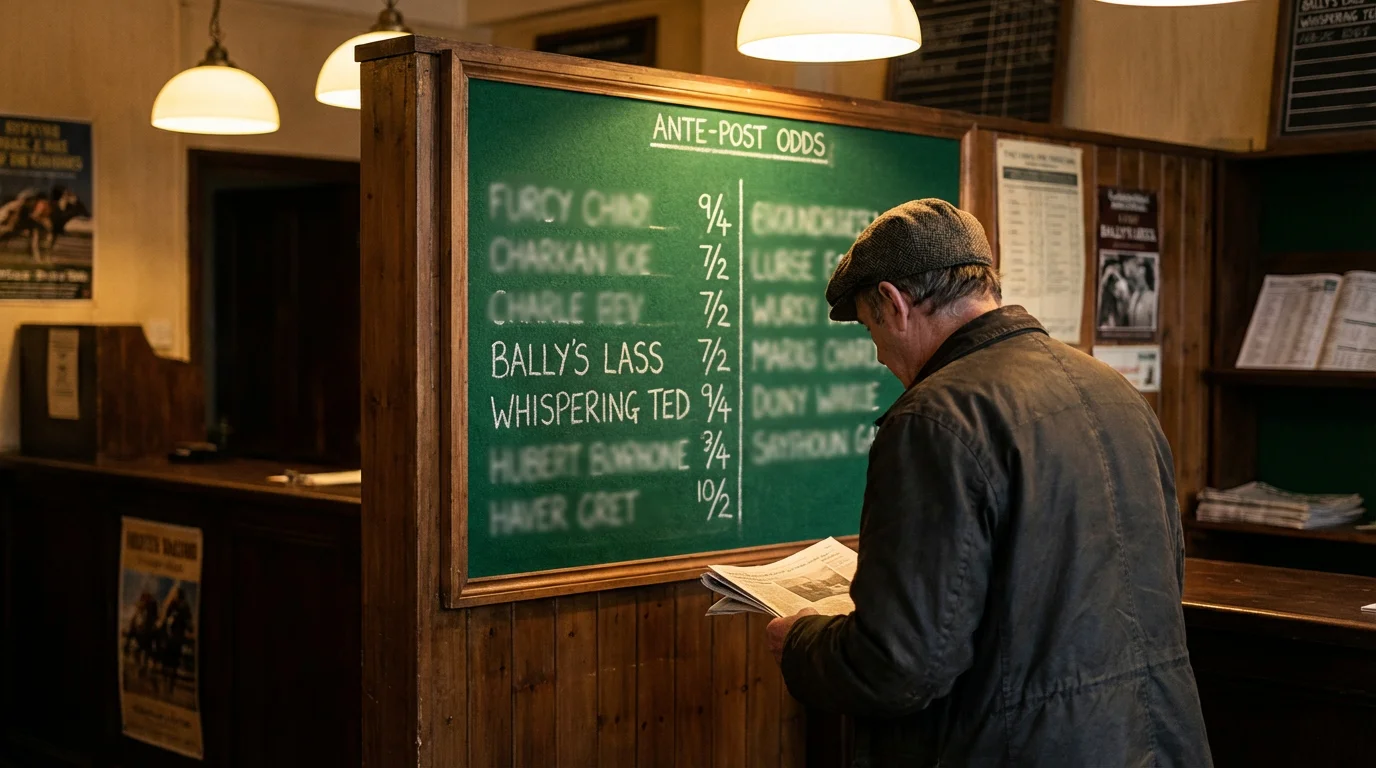
Ante-Post Odds Open Months Before the First Heat
The Derby ante-post market is the longest-running bet in UK dog racing. While most greyhound betting happens minutes before a race, the English Greyhound Derby operates on a completely different calendar. Bookmakers open outright winner markets weeks — sometimes months — ahead of the first heat at Towcester, and those early prices bear almost no resemblance to the odds you’ll see on final night.
That gap between early market and final market is where ante-post betting lives. It’s a bet placed before the competition begins, before the trap draw is known, before the qualifying rounds separate the genuine contenders from the also-rans. In exchange for accepting that uncertainty, you get odds that would be unthinkable once the semi-finals are run. A dog priced at 33/1 in March might be 5/2 by the time it reaches the final in June — if it gets there at all. Find more strategy guides at greyhoundderbyodds.
For most greyhound punters, ante-post is unfamiliar territory. The weekly routine of checking the card, scanning the form, and backing a dog ten minutes before the off doesn’t apply here. The Derby’s ante-post market demands a different kind of homework: assessing kennels, monitoring trial times, tracking entries, and deciding when the price is right. This article breaks down how that market works, where the value tends to sit, and when the smart money moves.
How Ante-Post Greyhound Odds Work
No refund if your dog doesn’t run. That’s the trade-off for longer odds, and it’s the single most important rule in ante-post betting. Unlike a standard race where a non-runner means your stake is returned, an ante-post wager on the Derby is final from the moment you place it. If the dog gets injured in training, fails to qualify, or is withdrawn for any reason, the bet stands and your money is gone.
Bookmakers price the ante-post market differently from individual race cards. On a normal Tuesday night at Romford, odds are compiled from form data, trial times, and market expectations, then adjusted as money comes in. The overround — the bookmaker’s built-in margin — is tight because the race is hours away and information is relatively complete. In ante-post markets, uncertainty is the dominant variable. Compilers are estimating not just which dogs will perform well, but which dogs will still be competing in six weeks’ time.
That additional uncertainty inflates the odds across the board. A dog that might open at 3/1 for a standard open race could be priced at 8/1 or 10/1 in an ante-post Derby market months before the heats begin. The bookmaker is compensating for the risk that the dog never runs — and passing that same risk to you. The flip side is obvious: if you’ve done your homework on a dog’s trial form, its trainer’s Derby record, and the likelihood it stays fit through the competition, you’re getting paid for knowledge the market hasn’t fully absorbed yet.
Ante-post Derby odds are typically displayed as fractional prices, the standard format across UK greyhound bookmakers. Early markets often feature as many as 40 or 50 dogs, with outsiders quoted at 100/1 or longer. As entries are confirmed and trial information filters through, the field narrows and prices compress. By the time the first heat is run, the market looks entirely different from its initial shape — which is precisely the point. The value window is open widest when information is scarcest.
Where to Find Ante-Post Value
Trainers with multiple entries give you more shots at a price. This is one of the simplest edges in the ante-post Derby market and one of the most overlooked. When a leading kennel enters five or six dogs, the bookmaker has to price each one individually — but the kennel’s overall chance of producing the winner is the sum of those individual probabilities. A trainer with four entries at 25/1, 33/1, 40/1, and 50/1 has a combined implied probability significantly higher than any single dog suggests.
The practical application is straightforward. Rather than backing one dog at a headline price, consider spreading a modest stake across two or three entries from the same kennel. If the trainer has a strong Derby record and a track record of bringing dogs to peak fitness for Towcester, you’re betting on a system as much as an individual animal. Graham Holland’s dominance in recent years illustrates the principle: his kennel regularly places multiple dogs in the latter rounds, and backing his entries collectively in the ante-post market has historically outperformed backing the pre-tournament favourite.
Trial times offer another route to early value. Before the heats begin, many trainers run their Derby entries in open trials at Towcester and other tracks. These times are published and available to anyone paying attention, but the market is slow to react. A dog posting a fast trial over 500 metres at Towcester in April won’t see its ante-post price adjust for days, sometimes not until the next round of market updates. That lag is your window.
Course form is the third pillar. Dogs that have raced at Towcester before, particularly over the Derby distance, carry an advantage that generic form doesn’t capture. The bends at Towcester punish dogs without course knowledge, and a strong previous performance there is worth more than a fast time at a different venue. When a dog with proven Towcester form is available at 20/1 or longer in the ante-post market, that’s a price shaped by the number of entries, not by specific form analysis.
Risks of Ante-Post Betting on Greyhounds
Injury, retirement, and form collapse are all priced into the odds — partially. The longer prices in ante-post markets exist because of these risks, but the pricing is imprecise. Bookmakers can’t accurately quantify the probability of a specific dog pulling a muscle in Round 3 or losing form after a kennel change. They apply a general discount across the field, which means the risk premium is spread unevenly. Some dogs carry more injury risk than their price reflects; others carry less.
Greyhounds are more injury-prone than racehorses over the course of a multi-week competition. A dog racing every seven days through six rounds of elimination is exposed to cumulative physical stress that simply doesn’t exist in a single-race event. Muscle tears, toe injuries, and general fatigue knock out contenders at every stage of the tournament. In a typical Derby, the ante-post market loses a third of its serious contenders before the semi-finals.
Withdrawal without compensation is the headline risk, but there are subtler dangers. A dog may be entered, make the first round, and then run poorly due to undisclosed minor issues that don’t warrant a full withdrawal. Your ante-post bet is still alive technically, but the dog you backed is no longer the dog you assessed. Similarly, trap draws in later rounds can effectively end a dog’s chances without it ever leaving the competition. A confirmed wide runner drawn in Trap 1 for a semi-final is still running, but the bet has already lost most of its value.
The practical defence against these risks is position sizing. No single ante-post bet should represent a meaningful portion of your Derby betting bank. Treat ante-post wagers as speculative positions — high potential return, fully expendable if they don’t come off. The professionals who consistently profit from the ante-post market do so across a portfolio of selections, not through a single high-conviction pick.
Best Time to Take a Greyhound Derby Ante-Post Bet
Too early and you’re guessing. Too late and the value’s gone. The optimal window for an ante-post Derby bet sits between those two extremes, and finding it requires paying attention to the competition calendar rather than the odds board.
The first window opens when the initial entry list is published, usually several weeks before Round 1. At this point, the market is at its widest: maximum number of dogs, maximum uncertainty, maximum odds. The risk is correspondingly high — you know which dogs are entered, but you don’t know their current form, fitness, or trial times. Bets placed here are essentially kennel-level plays: backing a trainer’s string rather than a specific dog, or taking a price on a previous year’s finalist that you expect to compete again. If you have genuine insight into a kennel’s preparation — from published trials, industry contacts, or a track record of following the trainer’s runners — this is where that knowledge is most generously rewarded.
The second window falls after Round 1 results are in. The field has been cut dramatically, the first round of racing has produced real data at the actual venue, and the market adjusts — but not instantly. Dogs that won their first-round heats impressively will shorten, but the compression takes 24 to 48 hours. If a dog you’ve been watching runs a fast heat from a tough draw and the ante-post price hasn’t moved yet, that’s a clear signal to act.
The third window is post-semi-finals, though by this stage the value is thinner. You know the six finalists, you know their trap draws, and the market is tight. Ante-post prices at this stage are close to what you’d get on race day, minus the non-runner protection. For most punters, the post-semi stage is better suited to individual race bets on the final itself rather than ante-post outright positions. The exception is if you already hold an ante-post position at a longer price and want to hedge or add to it based on the semi-final performance.
Early Bets, Long Memories
The best ante-post punters keep notes, track trials, and move first. They don’t wait for the market to confirm what they already suspect; they take a price while it’s available and accept that some of those bets will lose to circumstances beyond anyone’s control. That acceptance — the willingness to absorb non-runners and early exits as part of the process — is what separates serious ante-post bettors from casual ones.
The Derby ante-post market rewards a specific kind of patience: the discipline to form an opinion weeks before the public narrative takes shape, and the nerve to back that opinion at a price that reflects genuine uncertainty. Most punters find it uncomfortable to place a bet six weeks before the final on a dog that might not even qualify. That discomfort is exactly what creates the edge. The price you take in March or April is compensation for the ambiguity everyone else wants to avoid. Also explore our greyhound betting strategy.
If you’re going to bet the Derby ante-post, commit to the process. Watch the trials. Follow the entries. Note the kennel patterns. And when a dog you’ve been tracking shows up at a price that underestimates its chances, place the bet and move on. The result might not come for weeks, but the decision — and the value — was right at the time.
