Six Traps, Six Colours — The System Behind the Jackets
Every greyhound wears a numbered jacket. The colour tells you the trap. When six greyhounds burst from the starting boxes at speeds exceeding forty-five miles per hour (Towcester Racecourse), they become a blur of movement that would be impossible to follow without visual markers. The coloured racing jackets — one distinct colour per trap — solve this problem, allowing spectators, bettors, and camera operators to identify each dog throughout the race. The system is standardised across all licensed UK tracks and has been part of greyhound racing for decades. Get more race analysis at greyhoundderbyodds.
The trap number determines the dog’s starting position across the width of the track, from the inside rail (Trap 1) to the outside (Trap 6). That starting position influences the dog’s route to the first bend, its interaction with the rest of the field, and — in many races — the final result. The jacket colours are not cosmetic. They’re a visual code for a structural element of the race that every bettor needs to understand.
Trap Number and Jacket Colour Guide
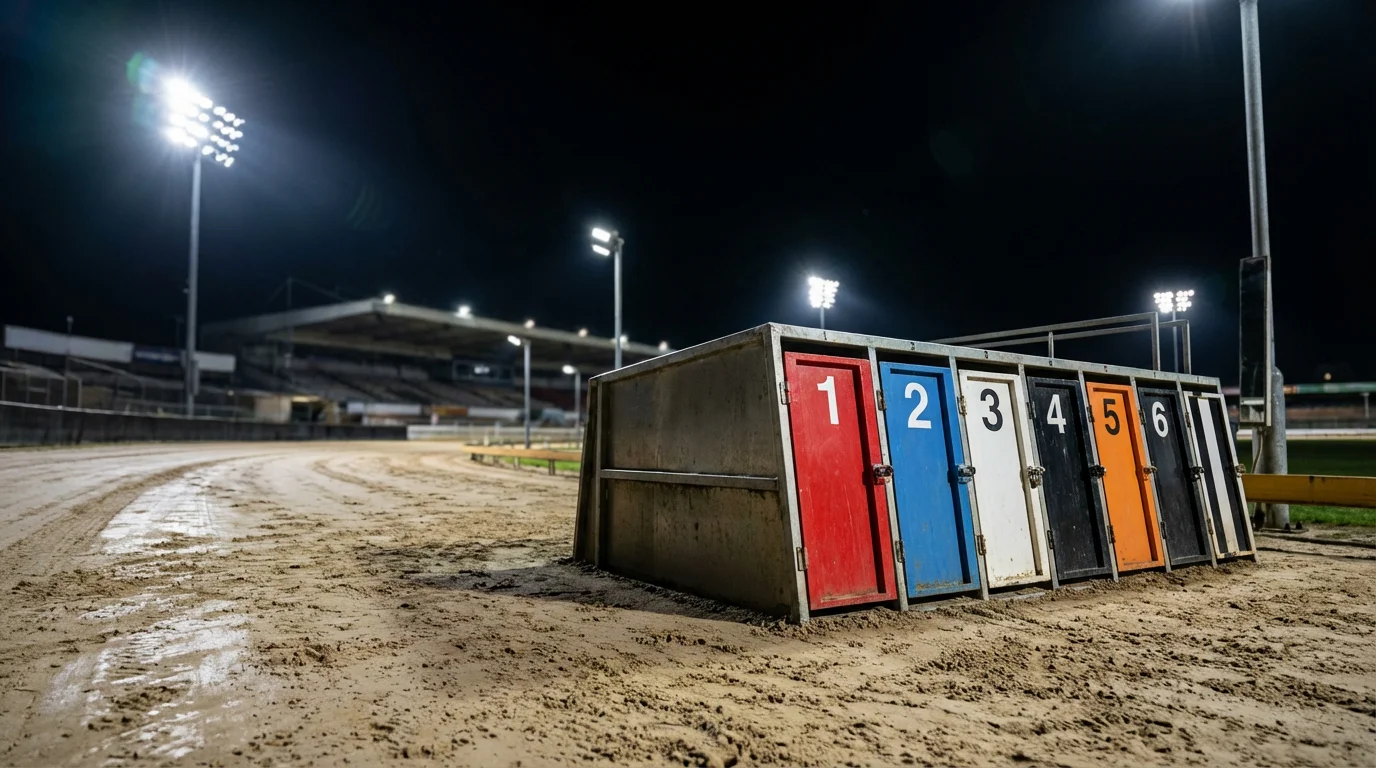
Trap 1 is red. The dog wearing the red jacket starts closest to the inside rail. Trap 2 is blue, starting immediately outside the red. Trap 3 is white, positioned in the middle-inside section. Trap 4 is black, occupying the middle-outside position. Trap 5 is orange, second from the outside. Trap 6 is black and white striped — sometimes referred to as “stripes” — starting on the far outside of the track (GBGB Rule 118).
These colours are universal across GBGB-licensed racing in the UK. Whether you’re watching at Towcester, Romford, Nottingham, or any other licensed track, the colour-trap assignments are identical. Irish racing uses the same system, as do most other countries where greyhound racing is conducted under organised rules. The consistency means that once you’ve learned the six pairings, they apply everywhere.
The colours are designed for maximum visibility under floodlit conditions. Red, blue, white, and orange stand out clearly against the sand surface and under artificial lighting, while the black jacket is distinguished from the black-and-white stripes by its solid colour. In practice, the most easily tracked jackets during a race are red (inside rail) and orange (far outside), because these dogs are typically on the extremes of the field and can be picked out against the other runners.
On race cards and in betting markets, dogs are identified by both their name and their trap number. The colour is implied by the number, so when a bookmaker lists a dog as “Trap 3 — White,” the colour is redundant but serves as a confirmation. When watching a race, particularly on a live stream where the resolution may be limited, knowing the colour assignments lets you track your selection through the field without relying solely on commentary.
Why Trap Numbers Matter for Betting
The trap determines starting position — and starting position influences the first bend. This is the central reason why trap numbers matter far beyond simple identification. In a six-dog race around a left-handed track, the dog starting in Trap 1 has the shortest route to the first bend and the closest access to the inside rail. The dog in Trap 6 has the longest route and must either cross the field to reach the rail or commit to running wide through the turn. Every other trap falls somewhere in between.
Across UK greyhound racing, Trap 1 wins more often than any other position — typically accounting for 17-19% of wins against a theoretical average of 16.7% per trap. The advantage is modest in percentage terms but consistent enough to be statistically significant over large samples. Traps 2 and 3 also tend to overperform slightly, while Traps 5 and 6 underperform. The exact distribution varies by track and by distance, but the general pattern holds: inside traps carry a structural edge.
The advantage exists because of how greyhound races unfold. The first bend is the decisive moment in most races — the point where six dogs converge from a wide starting line into a narrower racing formation. Dogs on the inside reach the bend first and can establish their position on the rail, while dogs on the outside must either use superior speed to cross the field or accept a wider racing line that covers more ground. The further outside you start, the more ground you lose at the bend — and in a thirty-second race, that lost ground is rarely recovered.
For bettors, the trap draw should be factored into every assessment. A strong dog drawn in Trap 5 is a different proposition from the same dog drawn in Trap 2. The form is the same, the ability is the same, but the structural challenge is different. Dogs drawn wide need to be faster, cleaner-breaking, or tactically smarter to overcome the positional disadvantage — and the price should reflect that additional requirement.
Reserve Runners and the ‘R’ Jacket
When a dog is withdrawn before a race, a reserve can step in wearing a distinctive jacket. Reserve runners are standby dogs listed on the race card in case a declared runner is scratched — typically due to injury, illness, or a veterinary issue identified before the race. The reserve takes the withdrawn dog’s trap position and runs from that box, regardless of whether the trap suits its natural running style.
Reserve runners are generally lower-grade than the declared field, because reserves are drawn from dogs at the track that night who didn’t make the original race card. Their form may be from lower grades or different distances, and they haven’t been specifically prepared for this race. For bettors, a reserve stepping in changes the dynamics of the race — the trap that the withdrawn dog was assigned to is now occupied by a potentially weaker runner, which can benefit the dogs drawn alongside it.
In major competitions like the Derby, reserves are handled differently. The substitution rules for knockout events are more formal, and a reserve entering a Derby heat is a notable event that can significantly alter the betting market for that race. When a fancied dog is withdrawn from a Derby heat and replaced by a reserve, the market usually shifts sharply — the remaining dogs shorten, and the reserve drifts to a long price. For sharp punters, these substitutions can create value on the remaining runners that the market takes time to fully price.
Trap Draw in the Derby — How It’s Decided
The Derby draw is made after each round. It’s random — and it changes everything. Unlike graded racing, where trap assignments are made by the racing manager based on running style and grade, the Derby trap draw is conducted randomly before each round. A dog that enjoyed Trap 1 in Round 2 might find itself in Trap 6 for Round 3. The draw resets the positional advantage with every race, ensuring that no dog benefits from a favourable inside trap throughout the entire competition.
This randomness is a deliberate feature of the knockout format. It ensures that the eventual winner has proven itself across multiple starting positions, not just from its preferred trap. A dog that can only win from Trap 1 is unlikely to survive six rounds of random draws, while a versatile runner capable of performing from any position has a structural advantage in the competition as a whole.
For punters, the round-by-round draw introduces a variable that can be assessed after each draw is published. When the draw for a semi-final or final is announced, the market reacts — dogs drawn in favourable positions shorten, and those drawn wide drift. The question is whether the market adjustment is sufficient. A dog that drifts from 4/1 to 5/1 after drawing Trap 6 may still be overpriced if its running style suits an outside start, or it may be underpriced if it’s a railer that now faces a significant tactical disadvantage.
Assessing the draw against running style is one of the most important skills in Derby betting. A wide runner drawn in Trap 6 faces less of a penalty than a railer in the same position. A fast breaker drawn in Trap 3 or 4 has the best of both worlds — clear space to reach the first bend without rail-side congestion. Matching what you know about the dog to what the draw demands is where the analytical work pays off, and it’s where you find the value that the general market, reacting to the draw in simple terms, often misses.
Colour Code Your Thinking
The trap draw isn’t a cosmetic detail. It’s a structural advantage or disadvantage built into every race. The coloured jackets exist for identification, but the numbers they represent carry real analytical weight. Inside positions win more often. Outside positions demand more from the dog. The Derby draw resets this variable randomly with each round, creating opportunities for punters who understand which dogs can handle which positions. Also read our best trap positions in greyhound racing.
Learn the colours, learn the numbers, and learn what each position demands. Then, when you see a dog drawn in a specific trap, you’ll know immediately what it means for its chances — and whether the odds have adjusted enough to account for it. The trap isn’t just where the dog starts. It’s where your analysis begins.
