
The Race Card Is Your Pre-Race Intelligence Report
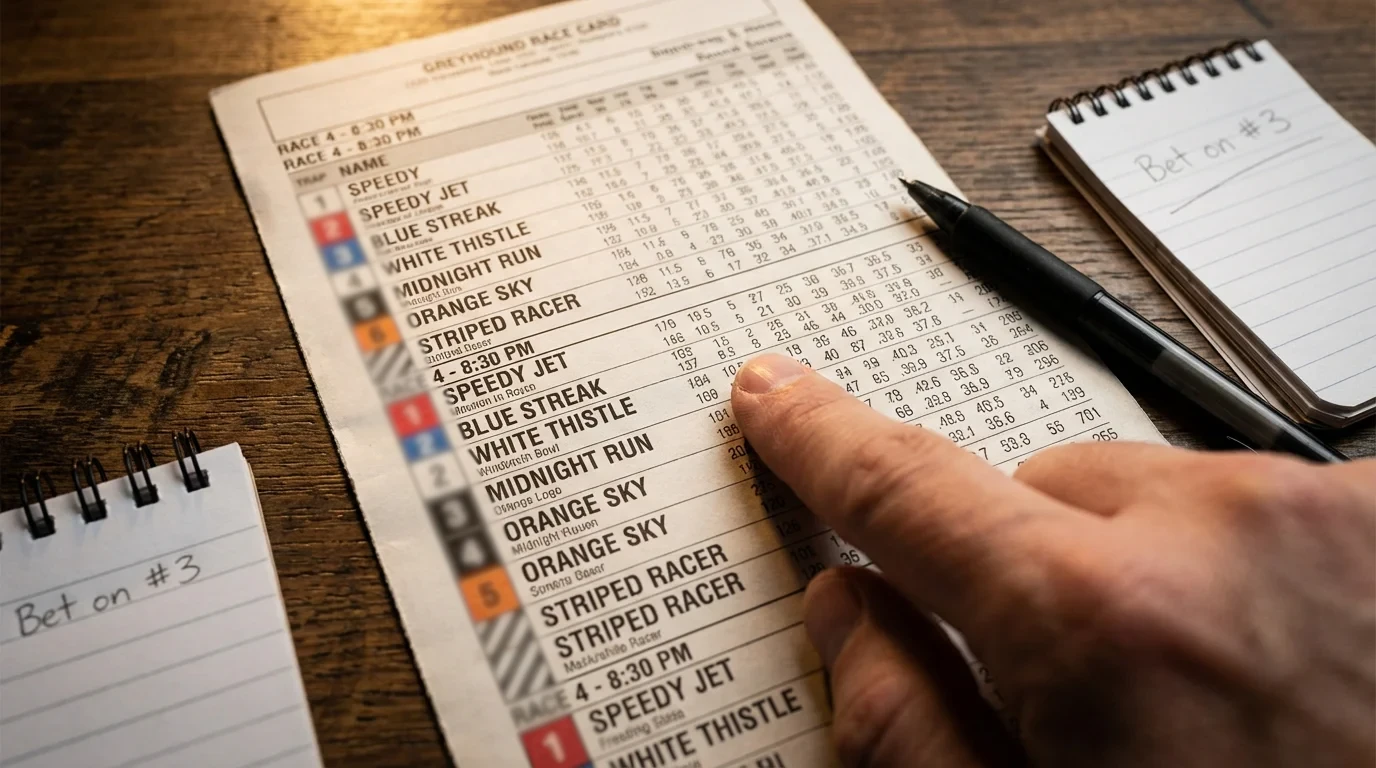
Everything you need to assess a dog is on one page. The greyhound race card is a dense, information-rich document that looks intimidating to newcomers but becomes intuitive with practice. It contains every data point a bettor needs to form an opinion: the dog’s identity, its trainer, its recent form, its best times, its weight, its trap draw, and abbreviated comments from its last few races. No other document in greyhound racing packs this much decision-relevant information into so small a space. Get more form guides at greyhoundderbyodds.
Learning to read a race card is the single most useful skill for a new greyhound bettor. Until you can look at a card and extract meaning from its columns, you’re relying on odds, instinct, or other people’s opinions — none of which give you an edge. The card gives you the raw material to form your own view, which is the starting point for any bet that isn’t a guess.
Every Element on a UK Greyhound Race Card
Dog name, trap, trainer, weight, form, best time, sectional — each one tells you something. A standard UK greyhound race card presents the runners in trap order, from Trap 1 at the top to Trap 6 at the bottom. Each line contains a block of information about the dog assigned to that trap.
The trap number and colour appear first. Trap 1 is red, Trap 2 is blue, Trap 3 is white, Trap 4 is black, Trap 5 is orange, and Trap 6 is black-and-white striped (GBGB Rule 118). These colours correspond to the jackets the dogs wear, making it easy to identify them during the race. The trap number also tells you the dog’s starting position — inside rail for Trap 1, outside for Trap 6 — which, as any regular punter knows, carries implications for racing line and first-bend position.
The dog’s name appears alongside the trap number, followed by the trainer’s name. The trainer information is more important than many beginners realise. Over time, you’ll learn which trainers specialise in which tracks, which kennels produce consistent open-class dogs, and which trainers have the strongest Derby records. This column isn’t just identification — it’s a quality signal.
Weight is listed in kilograms. A typical racing greyhound weighs between 27kg and 36kg, with most dogs falling in the 30-34kg range (Towcester Racecourse). Weight matters because it correlates loosely with running style and stamina: heavier dogs tend to have more power through the bends and better stamina over longer distances, while lighter dogs often have quicker acceleration from the trap. A significant weight change between runs — up or down by more than a kilogram — can signal a change in condition that affects performance.
Best time at the distance is usually displayed, along with the track where it was recorded. This is the dog’s fastest finishing time over the race distance, which gives you a ceiling for its speed capability. The limitation is that best times don’t account for track speed, race conditions, or the quality of opposition — a fast time on a fast track in an uncompetitive race means less than a slightly slower time at a tougher venue. Use best time as a reference, not a ranking.
The sectional split — usually the trap-to-first-bend time — appears on many race cards. This is one of the most valuable numbers on the card, telling you how quickly the dog typically reaches the first turn. A fast sectional means a dog that leads early; a slow one means a closer. At Towcester, the first-bend sectional is the single strongest predictor of finishing position, making this column especially important for Derby cards.
The form line — a string of numbers representing recent finishing positions — sits prominently on the card and is covered in detail in the next section.
How to Read the Form Line Numbers
The form line is the dog’s recent race history compressed into a sequence of digits. A typical form line might read 1111, 3226, or 5413. Each digit represents the dog’s finishing position in a recent race, read from left to right with the most recent run first. So 3226 means: third last time, second the time before, second before that, and sixth four runs ago.
A line of 1111 looks impressive — four consecutive wins. But what if it was all in A8 grade at Kinsley? The form line doesn’t tell you the grade, the track, or the quality of opposition. A dog winning four straight in A8 against the weakest dogs at a small track is a fundamentally different proposition from a dog winning four straight in A1 at Nottingham. The form line is a starting point, not a conclusion. You need to check the grade and venue of each run to give the numbers context.
Certain form patterns carry specific meaning. A line showing steady improvement — 4321 — suggests a dog that’s getting fitter and finding form. A line showing decline — 1234 — suggests the opposite: a dog that’s been promoted beyond its level or is losing condition. A mixed line like 1314 indicates inconsistency, which could mean the dog’s performance depends on external factors like trap draw or running room rather than pure ability.
Letters sometimes appear in the form line alongside numbers. “F” typically means a fall. “T” means the dog was brought down by another runner’s interference. These entries mean the run should be treated with caution — the finishing position doesn’t reflect the dog’s ability on that occasion, and the run before and after the incident may be more revealing. A dog showing 12T1 — two wins sandwiching a brought-down race — is almost certainly better than its form line appears, because the “T” was misfortune rather than poor performance.
Race Comments and What Abbreviations Mean
SAw means slow away. Crd means crowded. These shorthand notes reshape the story that the form line tells. Race comments are brief descriptions of each dog’s performance, written by the racing judge or stewards after every race. They appear on the race card underneath or alongside the form figures, and they provide the narrative context that raw numbers can’t convey.
Common abbreviations include: SAw (slow away — the dog was slow out of the trap), Crd (crowded — the dog was impeded by other runners), RIs (ran on inside — the dog railed), Wd (wide — the dog ran a wide line), Led (led — the dog was in front), EvCh (every chance — the dog had a clear run and still didn’t win), Bmp (bumped — the dog was physically knocked by another runner), and Fin (finished — typically followed by a qualifier like “well” or “tired”).
These comments are invaluable for distinguishing between performances. A dog that finished fourth with the comment “SAw, Crd 1” — slow away and crowded at the first bend — ran a very different race from one that finished fourth with “EvCh, Fin tired.” The first dog was disadvantaged by circumstances and might have won with a clean run. The second had every opportunity and faded anyway. The finishing position is the same; the quality of the performance is not.
For Derby betting, race comments from previous rounds at Towcester are particularly illuminating. They tell you how each dog handled the track’s specific bends, whether it was impeded by the draw or by traffic, and whether its finishing position reflected its true run. A dog that qualified through the rounds with comments showing repeated crowding and slow starts but still progressed is demonstrating resilience and ability that the form figures understate.
Turning Race Card Data Into a Betting Decision
Cross-reference form with trap draw, track, and conditions. The race card gives you the raw data. Your job is to synthesise it into an assessment of each dog’s chance in the specific race ahead — not in general, but in this race, at this track, from this trap, under today’s conditions.
Start with the form line and comments to establish each dog’s current level. Then check the trap draw and match it to the dog’s running style — a railer in Trap 1 is well drawn; a railer in Trap 6 is not. Look at the sectional splits to identify the likely early leader, because first-bend position is the strongest predictor of the result. Check weights for any significant changes. And note the trainer — a dog from a kennel in strong form at this track carries a signal that the card’s other numbers can’t convey.
The goal is to identify one or two dogs in the race whose chance is better than their odds suggest. The card won’t always reveal a clear bet — sometimes the market has priced the field accurately. When it does reveal a discrepancy between your assessment and the market’s price, you have a position worth taking. Every bet should be traceable back to something you read on the card, not something you felt in your gut.
Read the Card Before You Read the Odds
The odds tell you what others think. The card tells you what actually happened. If you look at the odds first, your assessment is anchored to the market’s view before you’ve formed your own. You’ll see a 2/1 favourite and start looking for reasons to back it, rather than assessing each dog objectively and seeing whether the 2/1 shot deserves its price. Anchoring bias is powerful and pervasive, and the simplest defence against it is to read the card — all six dogs, all the data — before you look at a single price. Also explore our greyhound racing form guide.
Build this habit early and it becomes second nature. The race card is the foundation of every good greyhound bet. It’s free, it’s public, it’s available for every race at every track, and it contains everything you need to form an independent opinion. Master it, and you’re already ahead of the majority of punters who skip straight to the odds and wonder why their selections keep letting them down.
